What is a forest?

Well… it depends. You might think that I’m being facetious here. When I ask this of my students, they immediately suspect that it’s a trick question. After all, I do describe myself as a forest ecologist. But if you pinned me down and forced me to respond then I would struggle to give a clear answer. In this post I’ll try to explain as clearly as I can, and thereby demonstrate that we have a real, serious problem.

Let’s get the etymology out of the way first. In Medieval English the word forest did not refer to a place with trees. Its original meaning was one of the King’s hunting grounds which were managed particularly to maintain populations of deer. Many of these contained trees, but that wasn’t their distinguishing feature. Some were actually heathlands. To this day Exmoor forest hardly contains any trees. Contrary to popular misconception, that’s not because they were cut down — they were never there in the first place.

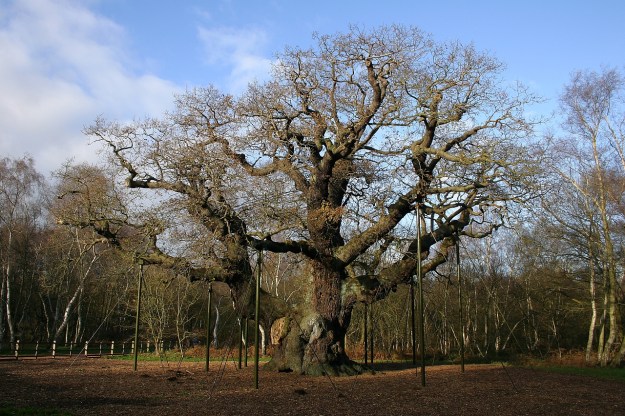
Here in Nottinghamshire I live only a short drive from Sherwood forest. Myths of outlaws in the wild woods are doubly fictional; neither Robin Hood nor his primeval haunt have any firm basis in historical fact. This has been a managed landscape for many thousands of years. A quick look at everyone’s favourite tree, the Major Oak, gives the game away.

Major_Oak_in_Sherwood_Forest_in_2006

Major Oak in Sherwood Forest in 2006 by Marcin Floryan.

This is not a tree that grew beneath a closed, dark canopy. Oaks in such situations grow tall and slender, forced upwards by strong competition for light. The north-east of the United States is carpeted in young oak forests, none of which contain trees shaped anything like the Major Oak. Its low spreading branches tell of a lifetime spent in a wide open area, surrounded by heathland, which has only in the last century been filled in by the mass of birch trees which now surround it. These birches are themselves a signifier; birch only grows in bright, open habitats when no browsers are around to eat its seedlings. If you wished to restore Sherwood Forest to how it looked at the time of Robin Hood, the first thing to do would be to cut down most of the trees.

The origin of the word ‘forest’ is therefore not much help in deciding what one is. The modern understanding is of an area covered in trees, so that’s a better place to start. But what is a tree, and how many of them does it take to make a forest?

Defining a tree isn’t straightforward either. Botanists, foresters and ecologists will all give different answers. Here’s my rather technical definition: a tree is any plant actually or potentially forming a free-standing monopodial stem of at least 1.3 m in height, with secondary thickening, and reaching a height of at least 5 m.

Let me parse that quickly so you can see where I’m coming from. The opening caveat ‘actually or potentially’ is necessary because it allows for the fact that many plants are capable of growing into trees, but haven’t got there yet (they might be young) or are prevented from doing so (e.g. by regular grazing or coppicing). A bonsai oak is still the same species as a giant oak, it’s just been constrained by a tiny pot. Free-standing is an attempt to keep out (most) lianas, which are structural parasites. Monopodial means having a single, dominant stem; this separates trees from shrubs, which have many stems and tend to branch below 1.3 m. As for the secondary thickening, that implies the existence of bark and other woody tissues, and excludes giant herbs such as bananas. The height of 5 m is arbitrary and intended to filter out any remaining shrubby species.

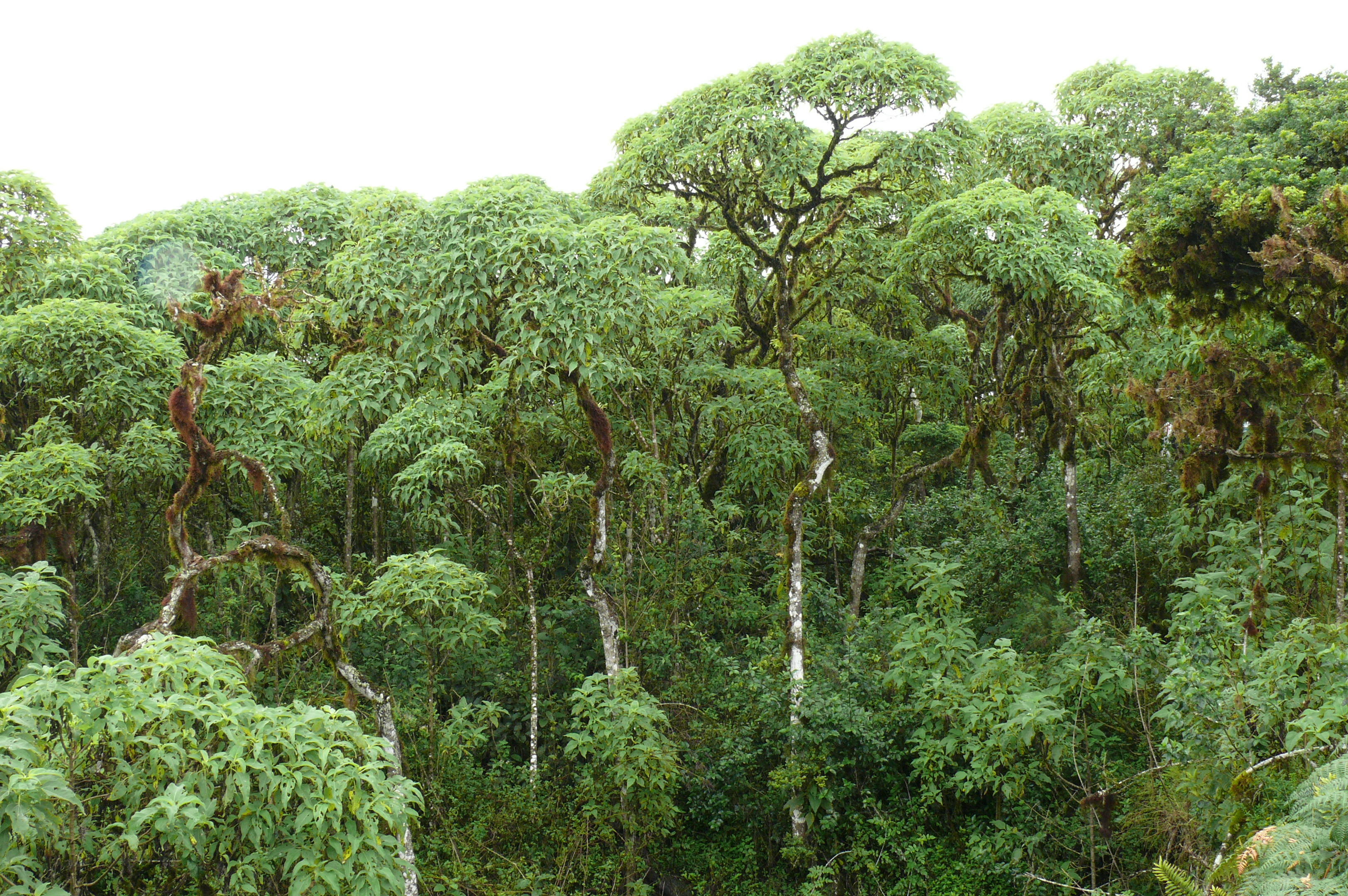
As an aside, almost any plant species is capable of evolving into a tree. Nowhere is this more obvious than on oceanic islands, where the chances of reaching them are slim, and therefore whichever plant is lucky enough to get there first can evolve into a dominant tree. On the Juan Fernández islands or in Macaronesia the native trees are actually lettuces, while tree sunflowers dominate forests in St Helena and the Galápagos, and tree silverswords in Hawaii show little resemblance to their weedy ancestors.

Scalesia pedunculata. It's a Galapagos tree, and also, basically, a daisy. By Haplochromis CC BY-SA 3.0 via Wikimedia Commons.

Scalesia pedunculata. It’s a Galapagos tree, and also, basically, a daisy. By Haplochromis CC BY-SA 3.0 via Wikimedia Commons.

There will always be some in-between cases but we’ll leave them to the specialists. Some lianas start their lives as small trees; some species can grow as either trees or shrubs; no-one really knows what to call a hemi-epiphyte like a strangler fig. Nature doesn’t easily fit into our boxes. Still, this gives us something to work with. It also ends up including species like oil palm, which are farmed as cash crops, and no-one would want landscapes dominated by them to be defined as forests. But we have to draw the line somewhere and specific chauvinistic exclusions would make a mockery of scientific impartiality.

It’s worth pausing briefly to note that the definition does create some perverse consequences. It’s not too dissimilar to that used by the FAO (Food and Agriculture Organization of the United Nations). A major bone of contention in their assessment of forest cover is the acceptance that any land which could grow trees is still a forest until its land use category changes. Completely burnt to the ground? Still a forest. Clear-felled? Still a forest. So long as trees are expected to grow there again one day, the FAO will call it a forest, even if there aren’t any there right now.

How many trees makes a forest? One common approach is to look at how much of the land surface area is covered by tree crowns, and I would personally draw the line around 40% (based on Sasaki & Putz 2009). Note that this is more restrictive than the definitions used by the UNFCC (United Nations Framework on Climate Change) or FAO.

All this causes further problems. My criterion includes things like orchards and rubber plantations, which are not forests by any folk definition. Likewise it excludes vegetation types with low tree densities (e.g. savannahs or dehesa) and shrublands. Some will get very sensitive about this because of the popular perception that conserving forests is the most crucial issue. I do not mean to devalue these landscapes, but would argue instead that these deserve separate treatment rather than attempting to cram them into an all-inclusive definition of forests.

South African fynbos. Undeniably a conservation priority, but calling it 'forest' doesn't help.

South African fynbos. A conservation priority, but calling it ‘forest’ doesn’t help.

Why does this matter? Well, deciding what a forest is makes a major difference in determining how much forest there is in the world. A new paper by Sexton et al. in Nature Climate Change points out that varying your criterion for tree cover from 10 to 30% changes the amount of forest recognised globally from satellite imagery by 6%. In other words, it’s a difference in area the size of China. In the tropics alone it represents a difference of 45.2 Gt of carbon. That’s a much bigger discrepancy than anything caused by arguments over defining a tree, or whether we should include rubber plantations. All those fine details drift into irrelevance.

While different countries are allowed to decide what they call ‘forest’ there will be political motivations to move the goalposts. If we’re trying to battle climate change by tracking the amount of carbon locked up in forests, or save species, or maintain ecosystem services, it’s pretty crucial to find out how much forest we have.  When NGOs bemoan ‘forest loss’, or governments declare successes in ‘forest protection’, you should maintain a healthy degree of scepticism about what they’re actually recording and where their figures are coming from. If we are to meet the Aichi Biodiversity Targets or use forest stocks to compensate countries for storing rather than releasing carbon through the REDD+ program then what we call a forest matters. It matters politically, financially, socially.

IDL TIFF file

IDL TIFF file

Global forest cover as detected from satellite data depending on whether one uses 10% (top) or 30% (bottom) land cover by trees as the criterion for defining forest (originals from NASA Earth Observatory, http://earthobservatory.nasa.gov/IOTD/view.php?id=86986&src=eoa-iotd).

All this argument leads to one basic conclusion, which is that the word ‘forest’ is a blunt and imprecise tool when it comes to describing the things we care about. Forests include areas that are old-growth, degraded, secondary or plantations, all of which have different sets of values depending on your perspective (see Putz & Redford 2009 for a great discussion). It is possible for serious degradation of habitats to take place without them ever ceasing to be called ‘forests’, and a dichotomy with ‘non-forest’ is unhelpful in documenting or preventing this. Forests are not merely present or absent.

Let’s just agree that many things can be called forests and stop arguing over the definition. More important is to ask why we care about forests, and start measuring the values that matter to us such as species, carbon, or services. Then, at last, we might be able to move past this distraction.

The most important day of my scientific career

You might imagine that the most important day in my career would be linked to a significant achievement. Perhaps my PhD viva, or my first paper being accepted, or when I was offered a permanent academic job. It could be the day on which I had a Eureka! moment of discovery*. It’s none of these. Actually it took place when I was an undergraduate, only 20 years old, entirely alone and a long way from home. No data were collected. I spoke to no-one. And yet I can trace my whole academic trajectory from that day.

The location was Kamchatka, a volcanic peninsula that protrudes from the far eastern edge of Russia. It’s 12 time zones from the UK, and even nine from Moscow. This is the wild east. I was there as part of a University of Cambridge expedition to visit the newly-created Bystrinsky Nature Park, which had been designated part of the Volcanoes of Kamchatka World Heritage Site. The region had only recently been opened to foreign visitors; a few years previously it was closed even to Russian tourists. There had been almost no work published in the international scientific literature since the great botanist Eric Hultén‘s Flora of Kamchatka, completed in 1930. It had nevertheless fascinated scientists, anthropologists and explorers since at least the pioneering expeditions of Krashenninikov (1711–1755). We were treading in noble footsteps.

The main difference was that we were idiots. That doesn’t mean that we were stupid; more that we were young, naive and nowhere near as well-prepared as we thought we were. I’m still very relaxed about sending undergraduates off to far-flung parts of the world in much the same state because it was such a formative experience. We learnt more through throwing ourselves into it than any lecture could have taught us. So long as you’ve made reasonable plans and thought about safety, go for it.

At the foot of Anaun volcano, September 1998. Photo by Valeri Vassilevich Yakubov.

Younger and with much longer hair, at the foot of Anaun volcano, September 1998. Photo by Valeri Vassilevich Yakubov.

As the flight landed in Petropavlovsk-Kamchatsky, the only notable town and regional capital, a full moon was bathing low clouds with an ethereal glow, punctured by the immaculate conical peaks of the volcanoes. I distinctly remember watching this mystical landscape beneath us and thinking — before I had even set foot in it — I must find a way to come here again.

Our chosen project was to examine the spatial patterns of the local forests. I’d read that they were a mix of birch and larch, which I was assured by the legendary Peter Grubb was impossible, since both species are highly light-demanding and unable to recruit beneath a canopy. It turned out that they were exactly as Hultén had described (which is documented in a later paper). Sadly we never published our findings; they were used for our undergraduate final-year projects then shelved as we moved on to other things. I have since returned, however, and am still following up on those first hazy impressions.

Enough of the background, what of the most important day? We had been surveying a forest of stone birch (Betula ermanii) a few kilometres east of the village of Esso. Stone birch is unlike any European birch — the wood is incredibly tough and the trees have a gnarled, low-branching form as a result of heavy snowfall in the long, cold winters, which gives them an interesting architecture. If anyone ever asks for my favourite tree, or favourite forest, then I can wax lyrical about them, but for now I’ll save that for another post.

Stone birch (Betula ermanii) in the Uxychan valley, west of Esso, Kamchatka.

Stone birch (Betula ermanii) in the upper slopes of the Bystrya valley, south of Esso, Kamchatka.

Our small team had finished work in the area and decided to head back to the village for a clean-up, change of clothes, hot meal and indoor bed. I wasn’t quite ready yet though, and opted to remain behind alone. Earlier in the trip we had attempted to climb the small mountain to the east but turned back in poor weather. I was determined not to be defeated and wanted a second shot.

It was that night that I had my epiphany. Alone in the forest, sat by a roaring fire and surrounded by nothing but trees, I realised that this is what I wanted to do with the rest of my life. I sat and wrote a letter to a friend **, drank the remainder of the vodka and watched a curious mink dance through the branches above me in the flickering light ***. Nothing much happened. I sang a few songs to keep myself company (and the bears away), went to bed and passed an uneventful night. There is no doubt in my mind though — that was the crucial moment to which I can trace back my passion to work in, describe and understand the architecture of forests. It’s what I’ve devoted my life to ever since.

The next day, almost incidentally, my strike at the summit was successful. I climbed back down, collected the tent, and walked back to the village to rejoin the team around nightfall. I revisited the same peak in 2008 on another expedition. Being especially eager to see it again, I reached the summit long before the students and other scientists. This was fortunate because I promptly burst into tears. That wasn’t the only time I cried with emotion on that expedition; the second time was a few month later, on what was the best day in my scientific life so far, almost exactly ten years after that solitary night in the woods. But that’s a story for another time.


* I’m still waiting for one of those. Or at least one that doesn’t, a few days down the line, turn out to have been completely misguided.

** An interesting side-story in itself. She was at the time on another expedition in New Caledonia. Not only did she eventually receive my letter, she replied, and I received it — perhaps the only time that letters have been exchanged between Kamchatka and New Caledonia. This was of course long before the days of global internet and constant e-mail access. She is now a well-known conservation biologist in her own right and has probably forgotten our correspondence.

*** Mink were introduced to the peninsula centuries ago by fur-trappers and were once one of its most important exports. They are now fully naturalised, and with so little hunting taking place, they have almost no fear of humans.

Why I stopped reading the literature

This year I stopped reading the academic literature. Not entirely, of course — that would be career suicide. Nor is this a deliberately awkward response to the latest hashtag tyranny of #365papers, where fellow academics post how many papers they’ve read either to impress others or make them feel guilty. Mine was an accident that has settled into a default state.

For the last decade I have been able to claim with confidence that I read roughly 1000 papers a year. Now when I say read, you should be given to understand that this doesn’t mean poring over every single word. The normal protocol is to read the abstract, skim the introduction, flick through the figures then read the discussion until it gets boring*. If there’s anything that needs further scrutiny then I’ll look more closely, but it’s rare that the methods will receive more than cursory attention, perhaps checking for a few key words or standard techniques. I think most academics would say that in practice this is how they read papers.

By the end of the week I’m not mentally capable of intellectually-demanding work like writing manuscripts or analysing data, unless the pressure of a deadline forces me into it. So I’ve tended to hold Friday afternoons as a drop-in time for my group, and spent the gaps between meetings looking through recent journal issues and reading papers. This has helped me keep up to date with novel ideas, exposed me to new studies, and honed my awareness of what types of things are getting published.

My pattern of work all changed in the last academic year because I was inflicted with a new module with sessions scheduled in the Friday afternoon slot. No-one wants that time, least of all the students. It’s perhaps only marginally less unpopular than 9am on a Monday morning. Who wants to be in a lecture when there are pubs to go to? (I mean on Fridays, not 9am on Mondays. We’re not all alcoholics in the UK.)

My journal alerts system (I use Zetoc) has build up over the years to incorporate a wide array of sources. There are tables of contents for particular journals, search terms for the fields that I specialise in, and even a few names of colleagues whose work particularly interests me. I’m lucky enough to not need to keep track of competitors because I work in a field that no-one cares about so there’s little risk of being scooped**. At this moment the total number of unread alerts is about to pass 300. Catching up on all of those has reached the point where it’s simply impossible, unless I take a few weeks’ holiday and spend the whole time on academic reading. Which I’m not going to do.

When I was a (more) junior academic I remember being told by (more) senior academics that they didn’t read the literature any more. This struck me as a great pity. One phrase that I heard second-hand, supposedly from Chris Thomas, was that he no longer reads the literature — he raids it. If you’re writing a manuscript and need a reference to make a specific point then you go looking for an appropriate paper rather than attempting to follow everything. Another colleague told me that he expects his group to be his eyes into the literature, and relies on them to spot important new publications, which he gleans from their manuscripts and recycles into the next grant proposal.

With mixed feelings I’ve realised that I’m now headed in the same direction. I’m coming to terms with the idea that, in many cases, my graduate students have a firmer grasp of the frontline of the field than I do. Perhaps this isn’t such a bad thing. Over the last few years while writing a textbook it’s been necessary for me to keep on top of the literature to make sure I’m up-to-date. When covering so many subjects at once this is an overwhelming task. Delivering the final copy to the publishers removed the ongoing pressure to read and read more. But why was that process not fun? How can someone who loves his research and is passionate about his field not unequivocally enjoy the process of reading and discovering more about it?

A clue comes from a Masters-level class on science writing that I’ve just finished. This year I introduced a new exercise: the students were asked to come along with a piece of writing that they enjoyed reading. This could be anything at all — a book, website, magazine, paper — so long as it was in prose. Out of a class of 35, only one brought an article from a scientific journal. There were a handful with popular science books (Dawkins, E.O. Wilson), but the overwhelming majority arrived carrying fiction books.

What does this tell us? A small sample size, I know, but at least it’s an indication. These keen and bright students, at a top university***, immersed in the scientific literature, don’t first think of an academic paper when they’re asked about the most enjoyable things they read. This is probably because, for the most part, academic writing is terrible. Not many people would choose to read it for fun in their spare time. I read constantly at home — but the pile of papers in the corner isn’t the first thing I reach for.

The purpose of our class exercise was to look at the structure of enjoyable writing and see whether there are lessons that can be learnt for our own work. The pointers were perhaps predictable but nonetheless helpful: shorter sentences, simpler words, a focus on engaging rather than impressing the reader. My hope is that one day some of these students go on to produce a higher quality of scientific prose than the general average. Perhaps, in our small ways, we can redirect the tenor of academic writing and make it more pleasurable to read. Who knows, it might get me reading again.


* They all do, even mine. It’s the point where the author switches from actually discussing the results and their implications, and moves on to tenuous speculation or unnecessary criticism of other people’s work.

** This isn’t quite true on two counts. Firstly, there are plenty of people working on spatial self-organisation in natural systems. My experience, however, is that they’re (almost) all nice, supportive and collegiate people who encourage one another. I’ve never got the impression that there’s any competition. The other reason why scooping isn’t so much of a risk is that in ecology, data is king. No-one is going to beat me to publishing papers on Kamchatkan forest organisation because I’m pretty sure that no-one else has those kinds of data.

*** That’s what we’d like to believe, anyway. We do pretty well in some league tables but aren’t as impressive in others. Mostly we end up in the global top 100 and the UK top 20.

Consult the index

I’m presently mired in what is one of the most tiresome, tedious tasks I’ve had to perform in my academic career. Bear in mind that I say this as someone who spent three years tracking levels of herbivore damage on 20 000 individual leaves as part of my PhD. I’ve counted pollen. I’ve catalogued herbarium specimens. This is an order of magnitude worse.

The task at hand is to produce an index for my textbook, Natural Systems: The Organisation of Life*, which is finally due to be published in March 2016. I knew that indexing would be hard. I didn’t quite appreciate how hard. And that’ while using LaTeX, which makes everything much more straightforward. I can’t even imagine having to do this in hard copy or (shudder) in Microsoft Word**.  There are some useful guides to indexing. There’s even a book called Index Your Book Fast, though one suspects that the time taken in reading it would more than offset any gains. None of them make it any easier.

While it’s not difficult to imagine an ideal index in abstract terms, actually putting one together is trickier. I’m currently working through the book sentence-by-sentence, deciding whether this or that term is a passing or substantive mention, whether it needs to be nested within other groups, and when I might ever finish. Who or what deserves a place in the index? Main concepts are obviously in. What about taxa, important people, study sites, species… where does it end?

As a book reviews editor myself (for Frontiers of Biogeography) I’m acutely aware of that typical complaint by reviewers that ‘subject X doesn’t even make it into the index!’ This could mean any number of things: that the subject isn’t covered by the book, that the index has omitted to mention it, or that the reviewer hasn’t read the book properly. A skim of the index is often one of the first things a prospective purchaser does while browsing and forms a central element of the impression a book makes. Getting it right is crucial because it makes a book more useful to future readers. Too long or trivial and it’s overwhelming; too short and it looks skimpy.

One might ask why I’ve bothered writing a blog post about a topic so dull as indexing (although if you’re finding this particularly fascinating then you should read The Indexer, the international journal of indexing). In part it’s as a corrective to recent posts which may have given the false impression of my life as one of tropical jaunts spent being pursued by dangerous animals. All that happens, but actually 9 months of my year is spent in front of a computer screen. I’m also keen that you realise, when you turn to the back of a book and flick through the index, that a surprising amount of work has gone into preparing it. And, in my case, a surprising amount of wine.


* The blurb on this site is a cut-and-paste from the original proposal, submitted three years ago, and doesn’t really capture the book content. The cover image is also under review right now. All this will be filled in over the next couple of months.

** I haven’t used Word in several years, and it’s made my life immeasurably happier. You could do the same.

Field notes from Uganda 8: Farewell, potatoes

It’s the end of the field course here in Kibale and I’m now looking forward to getting home. The day my plane lands there’s a wedding to attend, but even before that there are many things I’ve missed — my wife, hot running water, reliable electricity, my record collection, and the ability to walk in the forest without fear of being trampled by elephants.

On the very last night here I went out with a small group to look for bush babies. We were rapidly successful, scanning trees with our torches and looking for the orange reflections of their large eyes amongst the foliage. I was walking slightly ahead, looking for the next one, when from the vegetation at the side of the road, moving as silently as an iceberg, a large bull elephant emerged right in front of us. What are the chances. It made it clear that we were not welcome, but luckily wasn’t interested in causing us any further trouble.

The elephants will not be missed. There are, however, a number of things that I will remember fondly. In no particular order:

1. The potatoes. I’m not joking. The potatoes here in Uganda are the best I’ve tasted in my entire life, especially when roasted. I could eat them continuously. I’ve never had potatoes like them before and all others will pale in comparison. The only other foodstuff worthy of note are the doughnuts of death, which occasionally appear at afternoon tea — small blobs of hard, salty deep-fried dough. They’re basically vegetarian pork scratchings and they’re incredible, even though each one palpably reduces your life expectancy.

2. The students. Normally at the end of a field course I watch the tearful parting of the participants with absolute equanimity. It’s not that I’m glad to get rid of them so much as relieved at the lifting of responsibility and the peculiar social tension that results from the teacher-student relationship. On a TBA course, however, it’s completely different. All the students are mature post-graduates, all highly talented and motivated. It also helps that we’re not assessing them, which allows us to completely separate the important roles of teaching and support from any academic judgement. This dissolves one of the major social barriers, and not coincidentally, they learn a lot more as a result.

3. Primates. To quote Liza Comita, a fellow forest ecologist, if you’re going to do dull and repetitive fieldwork, do it somewhere with monkeys. I’ve never been anywhere with such a fantastic abundance and diversity.

4. This view in the morning:

frontview

One could easily get used to opening a front door to this view.

Some things, however, I won’t miss at all.

1. Ironing underpants and socks. This isn’t for aesthetic reasons, but to kill the eggs of the mango fly, which are often laid on wet clothes when they’re hung out to dry. On contact with skin the eggs hatch and the larvae burrow under the skin causing painful, infected swellings. One of the other teachers has pulled almost 40 larvae out following an unwise excursion to the swamp where they swarm in abundance. This has been enough of a warning to make everyone a little paranoid.

2. Finding an internet connection. In the Dark Ages, monks travelled the world looking for the exact location where the firmament was thinnest and their prayers would ascend most readily to heaven. High, desolate places were particularly favoured for establishment of holy sites. The same principle applies to obtaining a mobile signal in Uganda. I am sending this while sat on a pile of rocks on the hill above the field station. Returning to a place with reliable wireless will be a delight.

kate_internet

On this occasion, the internet beam fell around the septic tank

3. Elephant terror. Once you’ve had a bad experience with the elephants, every noise in the forest becomes a potential elephant. Branches swaying in the wind, an animal running away in the undergrowth, a hornbill squaking as it lands clumsily in the canopy. All these make me jump and scan for the nearest escape route. In most forests I’m confident that, as a human being, I’m pretty much the most dangerous animal around. Everything else tends to run away. Here I’m definitely not. It’s a new experience for me to be scared in the forest and it’s not one I’ve enjoyed.

4. This view in the morning:

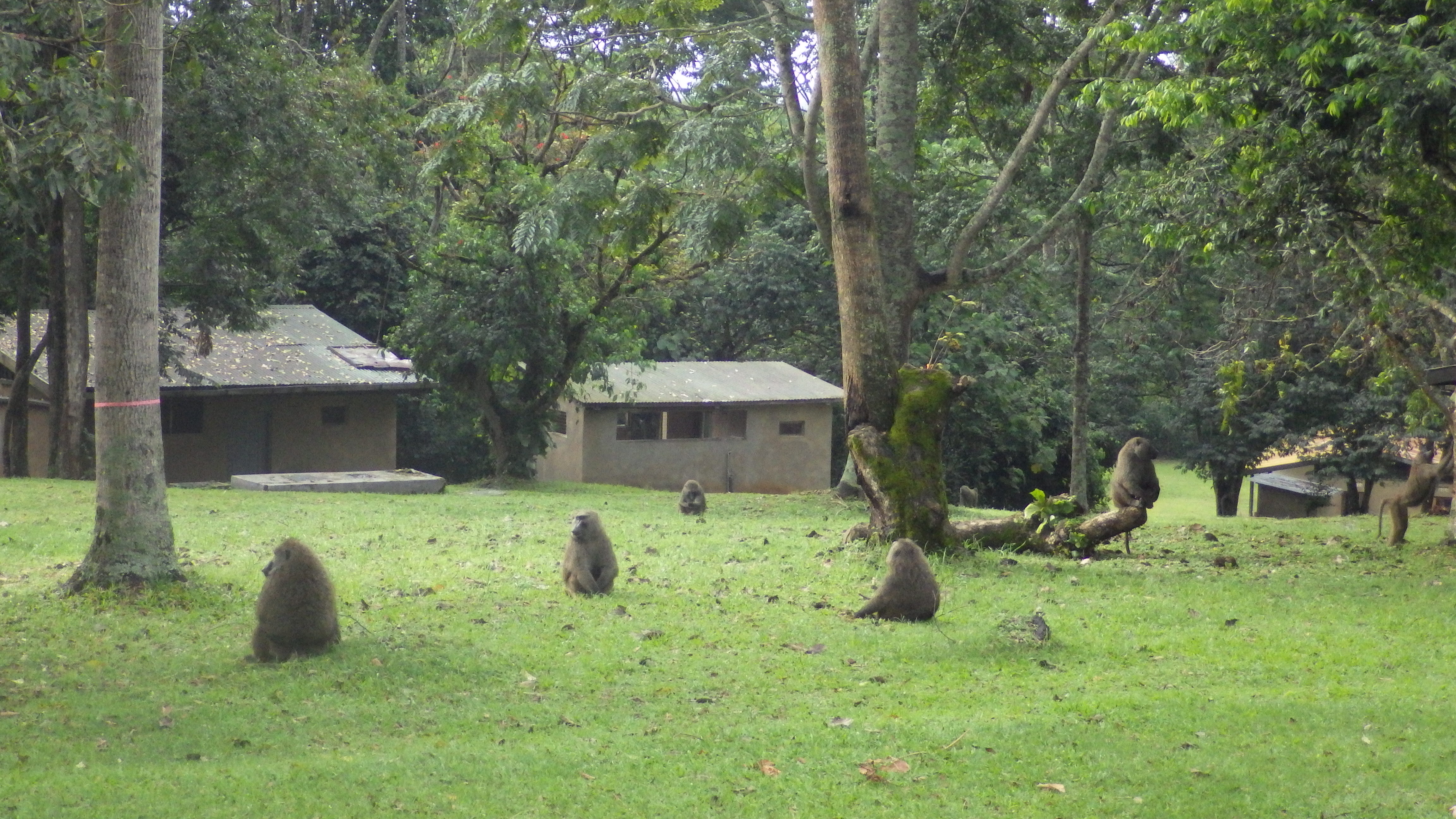
baboons

The baboons hold their morning conference to plot the day’s mayhem.

Actually, the baboons aren’t too much of an issue, so long as you ensure that your doors and windows are locked whenever you’re not around. They’re certainly not aggressive, other than to each other. In a place with limited electricity and internet, an no TV, they provide a permanent soap opera on your doorstep. The researchers who study them have almost come to love them. I doubt I’ll ever get that far but they at least provide good entertainment. It still baffles me though that a standard greeting among male baboons is for one to grab the other’s testicles. It’s one way to get their attention I suppose.

Field notes from Uganda 7: Journey to the Mountains of the Moon

The three teachers on our Tropical Biology Association field course here in Kibale abandoned the station for a day trip to the Rwenzori mountains, around two hours drive away (if nothing goes wrong, which it did). These fabled peaks are known as the Mountains of the Moon and comprise the tallest mountain range in Africa*. The Rwenzori Mountains National Park runs along the border with DR Congo where it merges with Virunga NP on the other side. Both are UNESCO World Heritage Sites.

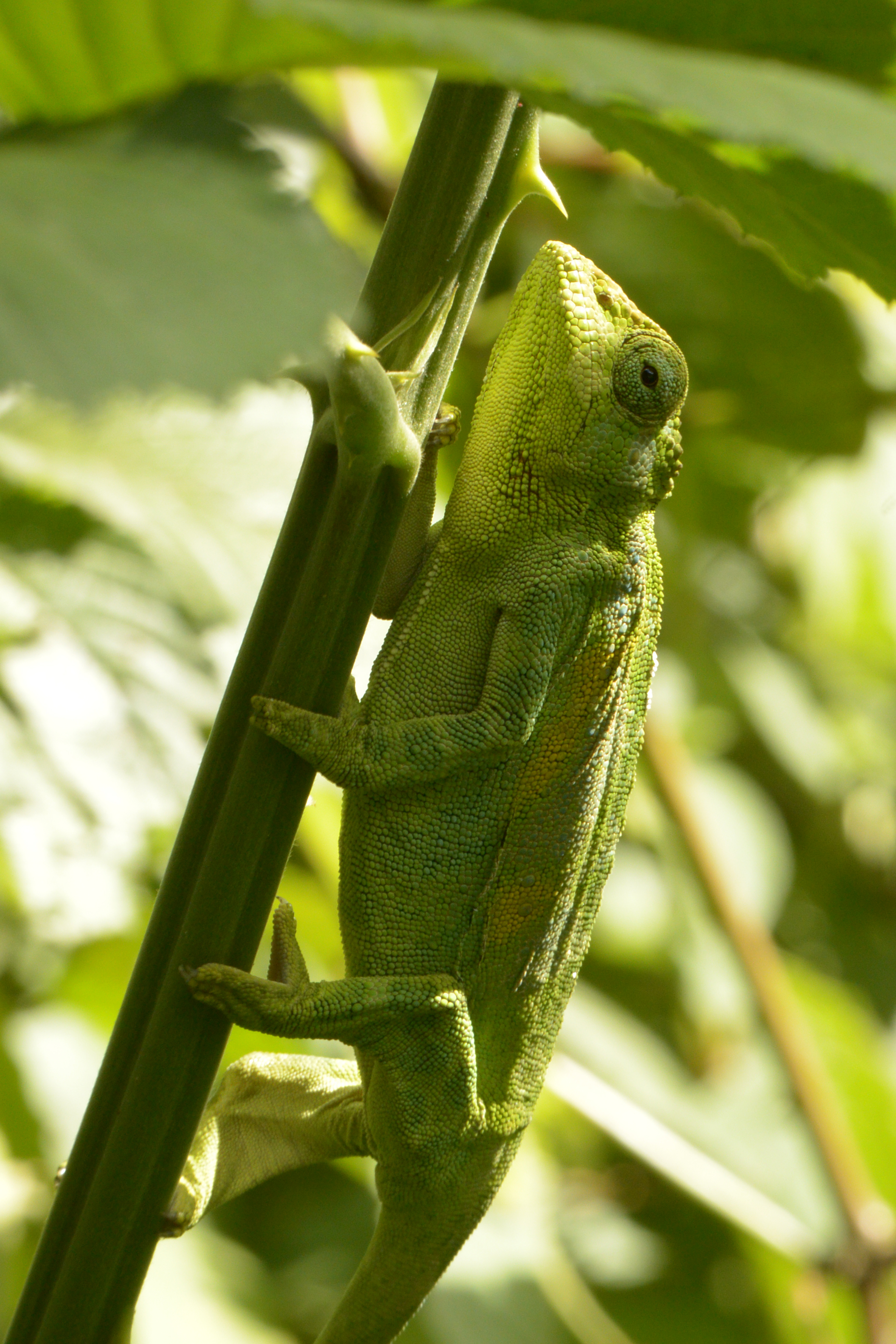
We began at the main park gate at around 1700 m and were led by our guide through several kilometres of valley floor which had been cultivated prior to the park’s gazetting. This remained in a rather sorry state, with little evidence of regeneration. I wondered why this might be the case, and whether this was a site where assisted regeneration through tree planting would be justified. Regardless of the stature of the vegetation, however, it makes good habitat for several of the endemic chameleon species, as well as an easier habitat for the bird watchers**.

kate_chameleon

One of the local endemic chameleon species — not easy to spot. Photo credit: Kate Lessells.

After a while the gradient steepened considerably as we ascended a knife-point ridge which afforded spectacular views on each side, as well as supporting a forest vegetation quite unlike the steep slopes. I say steep; if you fell then you wouldn’t bounce many times before reaching the white water at the bottom. It’s a wonder any vegetation clings to them at all, though in fact they’re covered by a mosaic of wooded patches and tangles of vines and shrubs.

After a 1000 m climb we reached the top of the ridge, panting and with burning muscles in our legs. We emerged into some delightful cloud forest. Trees were shrouded in the characteristic straggly Usnea lichens, and branches bore dense carpets of aerial-rooted epiphytes. Combined with the fresh breeze blowing across the mountains it was a narrow strip of paradise.

epiphytes

A carpet of epiphytes cover this branch hanging out over a steep ridge slope.

Above this, at around 3000 m, lay what I was really interested in — bamboo forest. I’ve heard about it but never had the opportunity to see it for myself. It was majestic; giant bamboos tower above you to a height of around six metres, and scattered amongst them are ancient Podocarpus trees which frequently exceed a metre in diameter.

Almost all the trees were large, with relatively few smaller stems. This made me wonder about the processes regulating these forests. I presume that episodic dieback of the bamboo (which happens after they flower en masse) opens up occasional opportunities for tree regeneration, perhaps only a few times a century. Those lucky recruits which manage to establish can then survive until the bamboo crowds around them again. This is my guess; once I get back to a reliable internet connection there will be plenty of reading to do.

bambooforest

Bamboo forest at around 3000 m asl.

We made it all the way to Lake Mahoma at 3000 m then returned after a thorough workout. Sadly there wasn’t time (or energy) to explore the heath forests that form the treeline, nor the endemic montane flora that lies above them. I’m intrigued enough by this landscape to already be planning a return.


I’ve completed the set! I have now seen in Kibale (drumroll please) black and white colobus, red colobus, red-tailed guenons, blue monkey, grey-cheeked mangabay, L’Hoest’s monkey, olive baboons and chimpanzees. Seven diurnal primates in one site and none of them hard to find (the nocturnal bush baby and potto are slightly trickier). It helps that so many of the groups are habituated thanks to generations of primatologists passing through.

Why are there so many primates here? I can’t give a definitive answer (though I’m sure that more informed people than me have speculated before), but suspect that part of the story lies in the age of these forests. Even those defined as primary show every sign of being in late stages of regeneration. Their canopies are short, dominated by long-lived pioneers which begin branching quite low, and with basal areas below 40 m2/ha. Whether they were cleared by humans or some catastrophic disturbance, the forests I’ve seen appear to be no more than a few hundred years old.

Why should this matter for primates? Long-lived pioneer trees have large leaves with high nutrient content, and often produce fruits which are animal-dispersed (and hence much favoured by frugivorous primates). Compare this to, for example, a much taller dipterocarp forest in Southeast Asia, where most of the leaves are practically inedible and most trees only fruit once every five or so years. Such forests are described as food deserts and primates exist at comparatively low densities.

It’s only a guess, but I can’t help feeling that the extraordinarily high diversity and abundance of primates here owes much to the relative youth of the forests.


Finally, some sad news. We heard this week that Dr Jerry Lwanga, the director of the Makere University Biological Field Station (MUBFS) at Kanyawara, and an instrumental force in the gazetting of Kibale Forest National Park, has died. I never met Dr Lwanga, but the sombre mood among the staff here is a reflection of the high regard in which he was held by all and their fondness for him. Everyone has spoken of him as a good man of impeccable probity and decency. Writing now from the field station which he founded, in the park to which he dedicated his career, it was certainly a life with many accomplishments.


* As individual mountains, Mt Kilimanjaro and Mt Kenya are taller than anything in the Rwenzori range, but they are both stand-alone peaks of volcanic origin. The Rwenzori peak of Mt Margherita is the third-tallest in Africa at 5109 m and is surrounded by a cluster of others which come pretty close.

** Apparently we saw the Rwenzori endemic purple-breasted sunbird. Or something. I include this information purely to irritate twitchers.

Field notes from Uganda 6: I am an elephant magnet

It’s official. I am an elephant magnet. Among over 30 people here on this Tropical Biology Association field course, I’m still the only one to have seen elephants in the forest. Three times. This last encounter was by far the most unsettling.

Most of the forest close to the research station here in Kibale is logged, and of the primary forest that remains, the majority is on steep rocky slopes where extraction of timber would have been impossible. I was getting a little frustrated at not seeing any tall-stature primary forest, but that may be because the forests here seem to be relatively young.

Yesterday afternoon I decided it was time to extend the range of my excursions and, following a tip-off from one of the local PhD students, I copied his GPS base maps and headed to the southeast, descending in altitude most of the way.

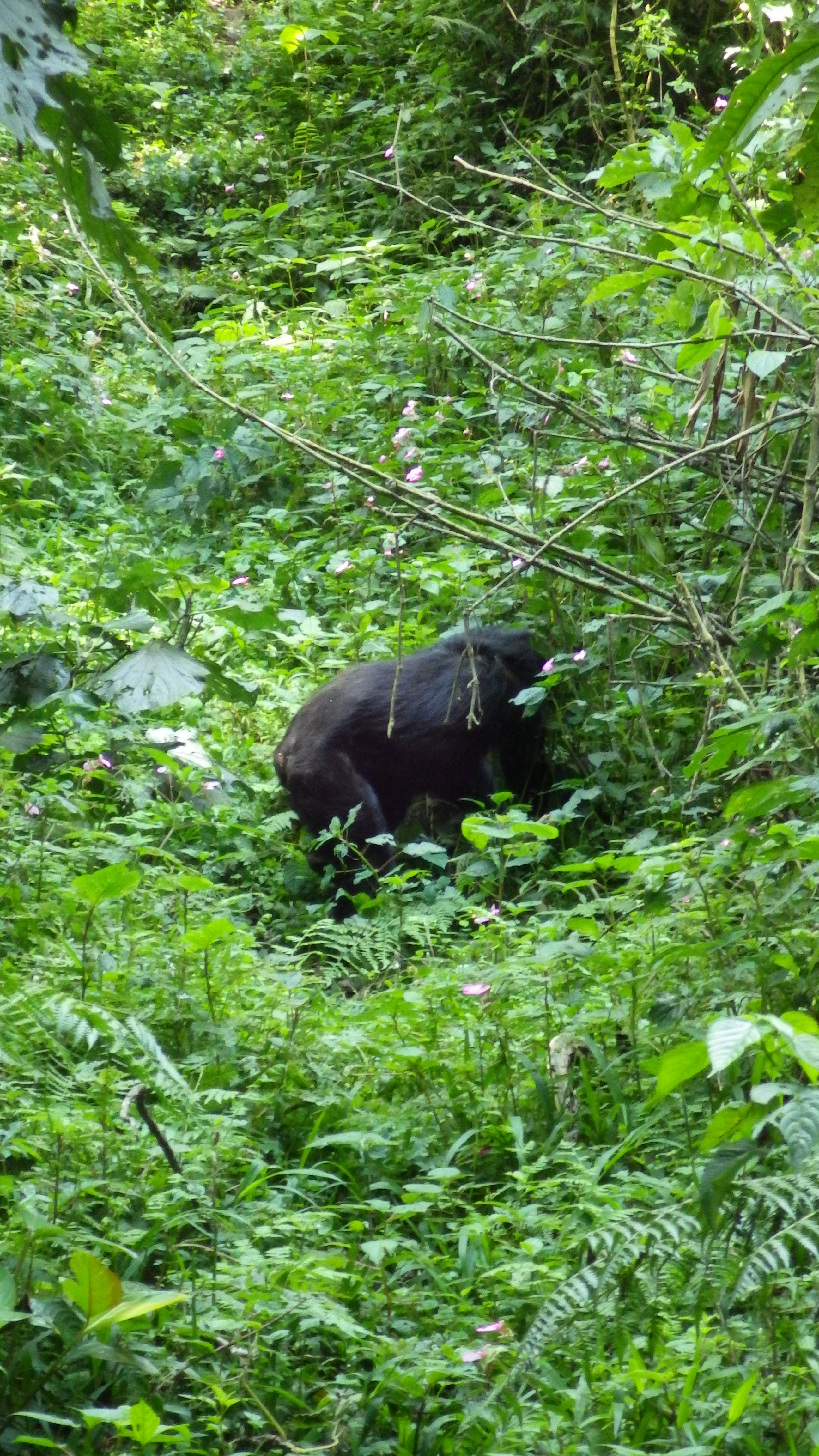
At one point I almost walked into a large male chimpanzee. Crossing a boggy patch at the bottom of a gorge and watching where I was putting my feet, I was already quite close before noticing him. Startled, I scampered back a few paces then looked to see how he would respond. Not a twitch. He cast me a laconic, disinterested glance, then continued grazing on a bush. I managed to take a couple of pictures before he moved on and allowed me to pass. I’m used to meeting orang utan in the forest, when that kind of proximity to an adult male would be a dangerous situation. It’s taking a little time to adjust to how habituated these chimpanzees are.

A large male chimp finally decides to vacate the path in front of me, in no particular hurry.

Eventually the trail ended, running into a larger orthogonal path that looked like it would connect with one of the main tracks through the reserve and give me an easy trip home. This led me for a mile through some beautiful dry forest which looked to be infilled savannah dominated by Olea trees. It had a nice, open understorey and some lovely views to forested ridges beyond. Having taken two hours to get out there I was tired but it was worth the effort.

Hill forest dominated by Olea trees with some spectacular lianas. Definitely worth a two-hour hike.

Sadly my chosen trial petered out, or rather it turned into a delta of narrow interweaving and overgrown paths through tall spiny Acanthus thickets. I knew the main trail was only a few hundred metres away, but it became increasingly obvious that the paths I was using had not been made by humans. This was exactly the kind of vegetation in which I met the elephants the first time, and visibility was only a few metres. Keen not to take many risks so far from base I turned back and retraced my steps for a few miles.

The outbound trip had been over some demanding topography, but there was a ridge trail to the north that was wide and easy-going, so I took a side trail up to meet it. On the way I passed an elephant wallow and a salt lick, which meant my senses were already tingling, but it didn’t look like there had been any activity there for some time. Nevertheless I was proceeding with extreme caution.

Meeting the ridge trail was a relief, though this was soon dispelled when I found a fresh pile of elephant dung. The ground was dry so there was no definitive way of knowing whether they were ahead or behind me, and this trail was the most efficient and direct route home. I proceeded with extreme caution, practically on tiptoes, listening constantly for any sign that there might be elephants nearby. There were broken branches and a characteristic stench that I’m belatedly coming to recognise. The problem was the trail, which had high banked walls with thick scrubby vegetation on each side. It didn’t offer many means of escape.

Rounding a corner I suddenly found myself metres away from the backside of a large male elephant. My heart was already pounding, but fortunately I had seen them before they saw me, and I was still walking as silently as possible. I crept back a short way then walked briskly back down the trail, putting some fast yards between myself and the herd. It was only when I heard movement — and they were out of sight — that I broke off the trail and sped into the forest.

This stuff is no fun to run through, especially with elephants on your tail.

This stuff is no fun to run through, especially with elephants on your tail.

The forest was filled with thick undergrowth on a steep slope, but I knew that my best course of action was to head west and get to the other side of the valley, so I aimed for the sun and pulled out my machete. I dropped right back down to the valley floor, waded through the swampy vegetation (if I’ve picked up mango flies I’ll be very displeased), then hacked up the other side. Here the GPS came into its own as I was able to eventually pick up another main trail on the next ridge which led safely back to base from the other direction, completely circumnavigating the elephants. Overall the diversion added several hard miles to the return journey. I made it back at dusk, shaken, soaked in sweat and exhausted. I then bought a beer.

Surely this can’t keep happening to me?


One of our students had a memorable though less pleasant encounter with the chimps. While measuring one of the liana plots, the chimp troop came past and the group of students decided, quite reasonably, to down tools and watch. One of the girls stood on the trail directly beneath a pair of chimps engaged in enthusiastic congress when a small deposit of something warm and slimy landed on her cheek. By all accounts this was not well-received.

In all the millions of years for which our two species have shared this planet, how many times do you think that has happened?

Field notes from Uganda 5: lianas — not just for chimps to swing on

I’ve been looking at tropical forests with fresh eyes on this trip, largely due to two books which I’ve been reading out here. The first, Second Growth by Robin Chazdon, is a compelling argument for the conservation of logged, degraded and secondary forests around the world. Far from being wastelands whose only worthwhile use is development or conversion to agriculture (hence the spread of oil palm), they should be viewed as valuable repositories of future diversity. Left to their own devices, or assisted when necessary, these forests can and will recover. It’s an important positive message regarding modern tropical landscapes. This isn’t to say that primary forests can be ignored — what remains still needs to be protected — but that regenerating forests have a crucial role to play in the future of conservation in the tropics.

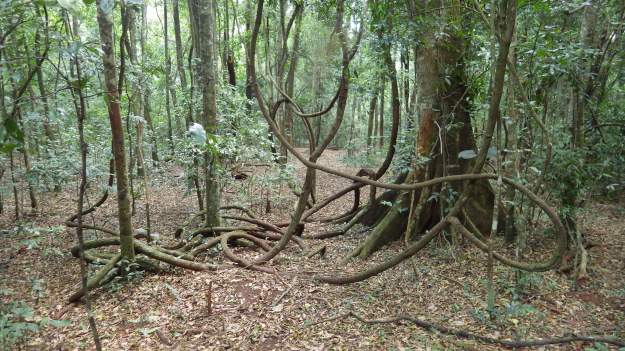
The second book is Ecology of Lianas which I’m reviewing for Frontiers of Biogeography (spoiler alert: it’s brilliant). Lianas have been neglected for a long time partly due to the difficulties of measuring them, and partly due to a belief on the part of foresters that they impede tree growth, and should therefore be stripped from forests. The former problem has been removed by the publication in 2006 of a standard protocol for the measurement of lianas, encouraging many new studies and allowing researchers across the world to properly compare their results. The latter belief is being dispelled by evidence that lianas are not merely structural parasites but important engines of forest dynamics and vital for the redistribution of nutrients. Far from being deleterious, current evidence suggests that forests regenerate at at least the same rate in the presence of lianas*.

lianas

A cluster of lianas ascend into the canopy. These large lianas are a characteristic feature of old-growth forests in this area.

Inspired by the liana book, and having noticed how little work has been done in East African forests, I now have two of my student groups doing projects on them. Their broad aims are to discern how the abundance, biomass, diversity and composition of lianas change between primary, logged and secondary forests. With just over a week to collect data we’re not going to add much to the sum total of human knowledge, but we will at least be providing some baseline data, and it’s a line of enquiry which I might follow up in the future. Maybe it will be my excuse to return to Kibale one day.


While walking through the primary forest taking pictures of lianas, I happened to hear some rustling in the canopy far above me, and looked up to spot two female chimps with young! This is the first time I’ve seen chimps in the wild, and given that there were also plenty of interesting lianas in the vicinity, it seemed reasonable to stop and see what happened.

After examining me carefully, and deciding that I wasn’t a threat, the chimps began gradually descending from their lofty perch, where two nests suggested that they had spent the night. For some time they paused in the sub-canopy, then eventually worked their way down to the ground and came towards me. One crossed the path carrying her baby, which dropped off her onto the trail and sat, contentedly watching me, while she rummaged through the vegetation just out of sight. The other female stopped less than ten metres away and sat playing with her baby, entirely ignoring me.

Chimps also like lianas, which provide food and a means of movement around the canopy.

Chimps also like lianas, which provide food and a means of movement around the canopy.

The chimps here are thoroughly habituated to humans thanks to decades of study. Research assistants are constantly in the forest tracking them and observing their behaviour. It’s therefore one of the few places where one can get so close to chimps without any sign that they are troubled by human presence.

Eventually I moved off, partly because I had other lianas to look at, but also because it was beginning to feel voyeuristic. It’s a cliché to remark on the similarity of chimps to humans, but in such close proximity it’s too striking to miss, and brings home that the savannah apes and the forest apes are not so different from one another.


* I should stress that liana tangles in seriously degraded forests are a different matter. In such cases they can arrest succession and form alternative stable states that make it difficult for the forest to recover.

Field notes from Uganda 4: Are the elephants following me?

It seems that I’m an elephant magnet. Yesterday I encountered a herd while walking alone in the forest. As one of the local researchers put it, everyone wants to see the elephants, until they do. Actually I would have been quite happy not to see them at all. Instead I’ve now run into them twice in two days.

Following a morning spent accompanying my student research groups in the field, I decided to take off on my own for the afternoon and explore the infilled savannah on the far side of the swamp. The Land Rover dropped me at the swamp and left, but I didn’t get far. About a kilometre further on I came across a large, very fresh pile of elephant dung in the middle of the trail. A few beetles had found it and were enthusiastically burrowing but there was still plenty to go round. The only question was whether the elephants were ahead of me or — worse — behind.

That was soon answered by a loud bellow from around 30 m ahead, accompanied by the sound of several large animals turning round and the crashing of bushes. I didn’t stop to take a closer look; I was off. Meeting elephants at close quarters is not an opportunity for a selfie.

Everyone has their own recommendation as to what to do if you meet an elephant (as, in boreal fieldwork, I’ve heard a thousand ways to escape a grizzly bear). Most of these are likely untested by experience. Mine is to head into thick woody vegetation, preferably downhill, on the basis that a medium-bodied primate is faster than a bulky elephant under such conditions. Machete in hand I put a rapid hundred metres between myself and the herd, checked that I wasn’t being followed, then tracked back to the trail lower down. There were many nervous glances over my shoulder all the way home.


This morning I headed out again, accompanying one of the local PhD students, who is studying parasitoid wasps. He has a set of Malaise traps collecting ichneumonids and braconids, and having already collected many hundreds of species, he’s estimating a total species richness in the thousands. A high proportion will be undescribed; these are not groups about which much is known and even the basic taxonomy is lacking.

We joked about my elephant escape, especially in light of his own experience a week ago. He accidentally stumbled into the herd while they were asleep and ended up climbing a tree to escape. He was stuck there for three hours. Luckily mobile phone coverage in the forest is pretty reliable, especially if you can get high up, so he was able to text friends back at camp and summon help.

As we were wandering along one of the main trails — what are the chances — the elephants appeared just in front of us. This time it was a relatively open area, and his field assistant counted seven adults with five juveniles. One mock charged so we didn’t wait around but luckily they didn’t seem in the mood to follow us.

Tomorrow I’m planning to go for a walk in the complete opposite direction. What can go wrong?


In a previous post I was concerned that the baboons were up to something. They finally struck. They’ve eaten my soap and run away with my toilet paper. This means war.

Field notes from Uganda 3: How do you solve a problem like savannah?

RIMG0786

Savannah in Queen Elizabeth National Park

We’ve just returned from a four-day trip to Queen Elizabeth National Park, one of Uganda’s flagship tourist destinations. It’s an extensive tract of savannah where one can readily see buffalo, elephants, hippos, and, if you’re lucky, lions or leopards.

What you won’t see are giraffes or zebra. Put aside for now that these glaring omissions are the result of staggering levels of poaching during the civil war. Their continued absence is a deliberate policy on the part of Uganda Wildlife Authority, who maintain the parks such that no single site contains the full complement of large animals. The rationale is that tourists will then travel around more and spread their largesse across the country. The obvious question is why would a wildlife tourist choose to come to Uganda when they could go on safari in Kenya or Tanzania and see all the big game in the same place?

RIMG0751

My curtains in QENP, which are the only place in the park to find giraffes and zebra.

Whatever one makes of this policy, it strikes at the heart of one of the most contentious debates in African conservation — how should savannahs be managed? Should it be to maximise the revenue from tourists, the enjoyment of local visitors, to minimise conflict with communities in and around the park, or to create systems as close to ‘natural’ as possible, whatever that is assumed to mean?

The problem is threefold. Firstly, there are a complex set of processes which act to create and maintain savannahs. While landscapes composed of scattered trees surrounded by grass form spontaneously in semi-arid areas with a pronounced dry season, there are large parts of the world where several types of vegetation are possible. They could turn into grasslands, savannahs, scrub or even closed-canopy dry forest. Multiple outcomes are possible.

Which one is found at any given site depends not solely on the climate but on the densities of large herbivores and the fire regime. Herds of species such as buffalo favour grasses, which are tolerant of grazing, and prevent woody seedlings from establishing. Larger animals like elephants feed on and break up woody vegetation. Grasses are also highly tolerant of fire, whereas tree seedlings are vulnerable, which means that regular fires hold back the trees and maintain open areas.

RIMG0810

Fires keep trees in check and promote grasses.

The twofold problem in the modern era is a dramatic reduction of the densities of large herbivores, and increased control of burning. This has led to shrub encroachment, widely believed to be a management problem. But this points towards the second issue, which is that there is no clear baseline to work towards.

Photographic records from a century ago show clearly that woody vegetation has expanded at the expense of open grasslands. Yet even when these photos were taken, they represented the state of savannah systems following several centuries of colonial game hunting and land management. This built on thousands of years of occupation by hunter-gatherers and native herdsmen, who were at the time being driven from the land. A general shortage of reliable palynological evidence (long-term pollen records) only further confounds the issue. We have no accurate means of determining what savannahs ‘should’ look like, or what that even means. Change is constant, from the scale of seasons to alterations in the balance between woody plants and grasses throughout the ice ages.

Savannahs are really a dynamic mosaic in which the shifting fortunes of trees and grasses are determined by changes in the climate, the populations of large animals, and the frequency of fire. The concept of ‘climax’ vegetation is of no use here. In a wet tropical rain forest it’s clear what state the system will default to once left alone. In a savannah we can only wait and see, or manage for what we prefer.

The final problem is that two other notable and crucial species are missing from these savannahs. The first is a tragic indictment of the greed and stupidity of humans — rhinos. The landscape in QENP is dominated by large Euphorbia candelabrum, which are practically inedible to all the local species, but are greatly favoured by rhinos. How different would this park look if the rhinos returned? Right now it’s a rhino buffet. If only we could guarantee their safety, and an end to their pointless exploitation for the sake of a medical myth, the landscape would appear very different.

RIMG0764

These large Euphorbia are delicious for rhinos, but ignored by everything else (elephant for scale). Would they be so abundant if rhinos were still here to eat them?

The last species that’s missing is easily forgotten because no-one realises that they’re threatened. It’s a keystone species, crucial as an ecosystem engineer, seed disperser and top predator. It’s also a charismatic primate averaging 60 kg in size, with fascinating behaviour and cascading impacts across savannah ecosystems. Does this ring any bells?

Modern humans evolved in Africa around 150 000 years ago from an ancestor which was also a savannah ape. For thousands of years they have managed these landscapes, particularly through fire. Burning was a tool not only to drive out game but to maintain open areas where hunting was easier and grassy plains where prey were abundant. More recently domesticated cattle spread across Africa, and all this long before the depredations of the modern era. These days we tend to assert that the only way to protect natural systems is to exclude people. But what if people are part of the system? Would it be reasonable to reintroduce the rhino but not the hunter-gatherer?