Tag Archives: teaching

Field Notes from Uganda 2: An unwanted frog and a gift from the baboons

Dr Rose Badaza, a pteridophyte taxonomist, was leading a group of students to learn basic fern identification. Despite her short stature she’s a formidable personality with an air of command.

It’s often difficult to engage students in plants when their primary interest is animals; they’re so easily distracted. At one point one of the students picked up a frog, eliciting the usual cooing from the group, who all clustered round. Rose was unimpressed. Her eyes swelled and her lip trembled in mock apoplexy. “Put that frog down!”, she declared, turning heads within a five mile radius. “We are botanists. The frog is our enemy.” Duly chastened, the student gently released his prize.
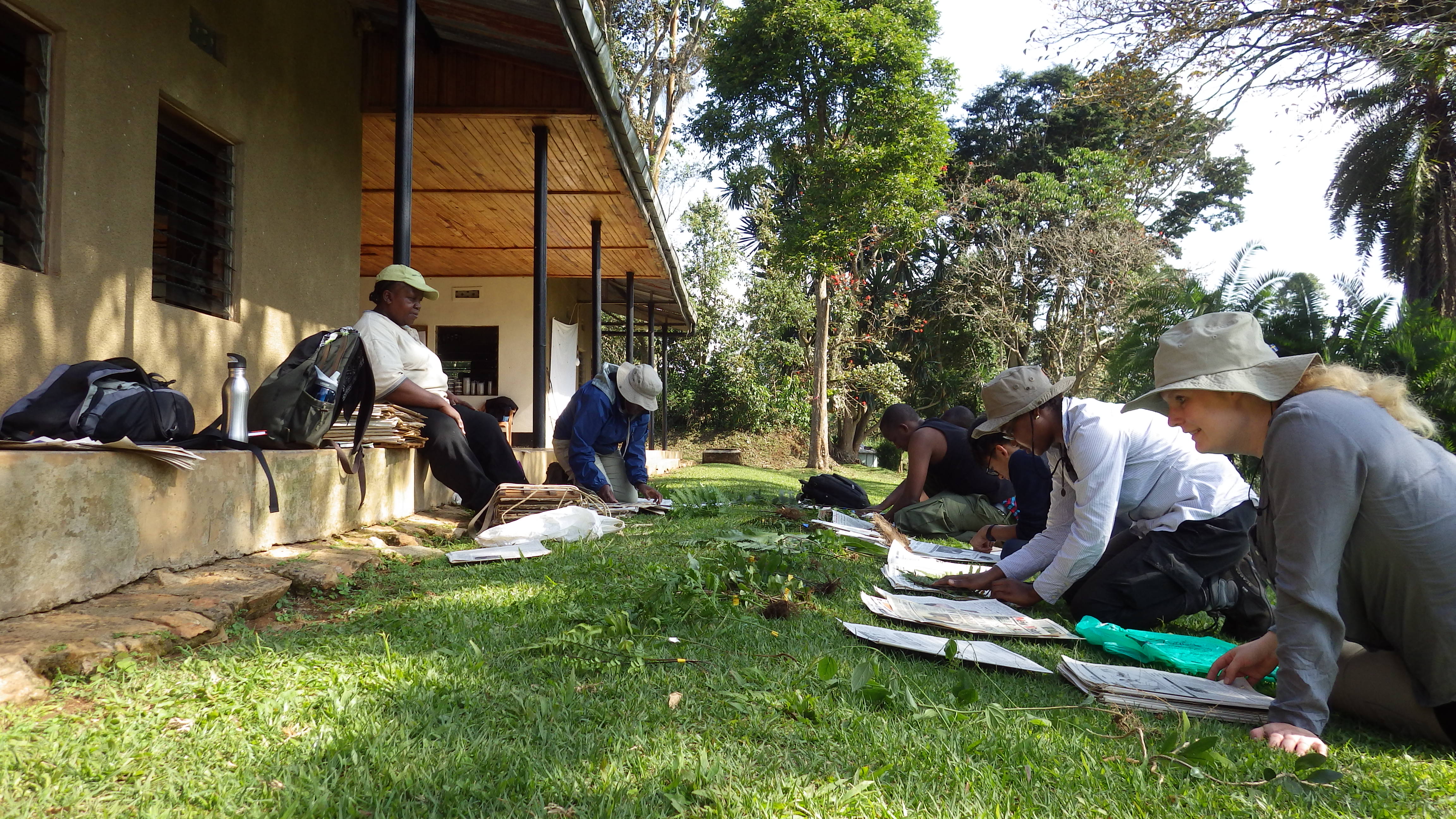
The students present their tributes to Rose for inspection.

The students present their trophies to Rose for inspection.


With some downtime this afternoon I took a stroll through the home gardens in the village adjacent to the forest reserve. As I rambled along, familar small shapes darted through the bananas just out of sight, calling out “Msungu! Msungu!” and the occasional “How are you!”, though too shy to wait for a response.

As I turned to head back, one bolder child stepped out and beckoned me to follow. Approaching a hut just off the trail, a gaggle of children emerged, and all became clear. They had run home to smear their faces with white chalk, and were now excitedly dancing up and down, pointing at themselves and chanting “Msungu! Msungu!” with broad smiles on their faces. These days blacking up is considered terribly offensive. But whiting up? I’m fine with that.

Imitation is the sincerest form of flattery.

Imitation is the sincerest form of flattery.


One of the great nuisances here at the field station are the olive baboons, which prowl the compound in amongst the chalets, waiting to seize any chance to break in and help themselves to whatever foodstuffs they can find. The windows are barred but constant vigilance is essential. We have been warned of many occasions when they have discovered an overlooked entry point and wreaked havoc within.

Returning to my chalet this evening I found, carefully deposited on my doorstep, a partly-gnawed avocado, while a cluster of baboons sat at some remove watching my response. How should I treat this — as a peace offering? A gift? Is reciprocal altruism expected? I stepped over the abandoned fruit, then closed and bolted the door behind me. The avocado has since vanished along with the baboons. I fear that my insult will not go unpunished.


Butterfly ecologist Dr Perpetra Akite demonstrates her unusual collecting technique.

Butterfly ecologist Dr Perpetra Akite demonstrates her unusual collecting technique.


Field Notes from Uganda 1

I’m in Uganda this August teaching on a Tropical Biology Association field course. The idea is to bring together an international group of graduate students, an equal mix of Africans and (mostly) Europeans, which creates a real melting pot of backgrounds. Over intermittent blog posts I’ll be recording observations as we go along *.


On arrival in Entebbe I went for a wander in amongst the homesteads by Lake Victoria. With a longstanding interest in agroforestry, I’m always intrigued to see what people are growing. Down near the shore, goats were being harried amongst cassava, sago and other familiar crops. It’s always reassuring to see the same types of cultivation all across the tropics. As I turned one corner a man pushing a bike arraigned me. “Ah!” he exclaimed, apropos of nothing, “Finally you’re here!”. I responded gnomically in kind and continued.

A little further on I spotted some more interesting plants — indian rubber, a few Cecropias, exotic figs — and decided to investigate. The track widened and suddenly I found myself in an area with a diverse range of large, widely-spaced trees, and trimmed lawns between them. Puzzled but distracted by the trees I passed a nursery and headed inside to look around. There was a fantastic jumble of plants of all forms packed into overflowing shadehouses. I introduced myself to the women working there and discussed what they were growing.

After a little while I asked one of them what this place was. She looked at me with benevolent disdain. “It is a nursery”. I made a more expansive gesture, indicating the wider area. Her expression became more quizzical. “What do you mean? You don’t know?” I pulled my best baffled msungu look and waited. There was an animated conversation in swahili and much laughter. Finally she turned back to me and said “It is the botanical gardens!”


It’s not many years since there were bombings in Kampala, which means a robust security presence everywhere, even if their attentions are not necessarily strict. In the wake of the Nairobi shootings, shopping centres are seen as a potential target, and everyone is checked on entry. Mirrors are held under vehicles to check for bombs, while large signs demand that shoppers surrender their weapons at the gate.

My collegue Johan, a large animal ecologist, went to the local supermarket to collect a few essentials. On entry his bag was given the usual inspection, a little less cursory than usual as it contained several intriguing items of field equipment. One of the guards took particular interest in the binoculars, removing them and staring through them intently. “Are you checking that they’re really binoculars?” Johan asked, a little impatiently.

“No” replied the distracted guard, still pressing them to his face. “I want to look at that girl over there.”


A road sign: ‘Dangerous School Ahead’.


Driving across Uganda from Entebbe to Kibale provided an opportunity to get a measure of the country. Not so much from a landscape perspective, since everything near a major highway tends to be badly degraded, but a more nebulous feel for the prevailing mood. We all have our own points of reference though, which dictate our experience of a new country.

A colleague from Zimbabwe was particularly impressed with the general level of activity. The shops along the roadside are full of goods and a healthy commercial bustle. The roads are busy with well-kept vehicles. There was no sign of the groups of listless, loitering men that are a symptom of economic stagnation. Everyone had an industrious air and a sense of purpose. Moreover, he noted how healthy everyone looked, and rightly so. This was not only true in the suburbs of Kampala, where one might expect a thriving urban population, but out into the rural areas. This is not to blithely suggest that Uganda has no health problems, but rather that the visible signs are of a thriving populace.

My impressions differed somewhat because my comparator is elsewhere. I can’t help but contrast it with Southeast Asia, and what struck me is how similar everything looks to the way Malaysia and Indonesia were about 15 years ago. I was delighted by the hand-painted advertisements on the sides of houses, now a rare sight in SEA. The densely packed, road-facing lines of shops are also increasingly being replaced by centralised commercial districts. All this I say not as a critique, but in a spirit of optimism. I’ve witnessed the rapid transformation in SEA this century and there is every sign that Uganda is travelling in the same direction. What this will mean for the forests — that’s another story.


* No photos I’m afraid. The internet is far too weak. I might add pictures at a later date.