Field Notes from Uganda 2: An unwanted frog and a gift from the baboons

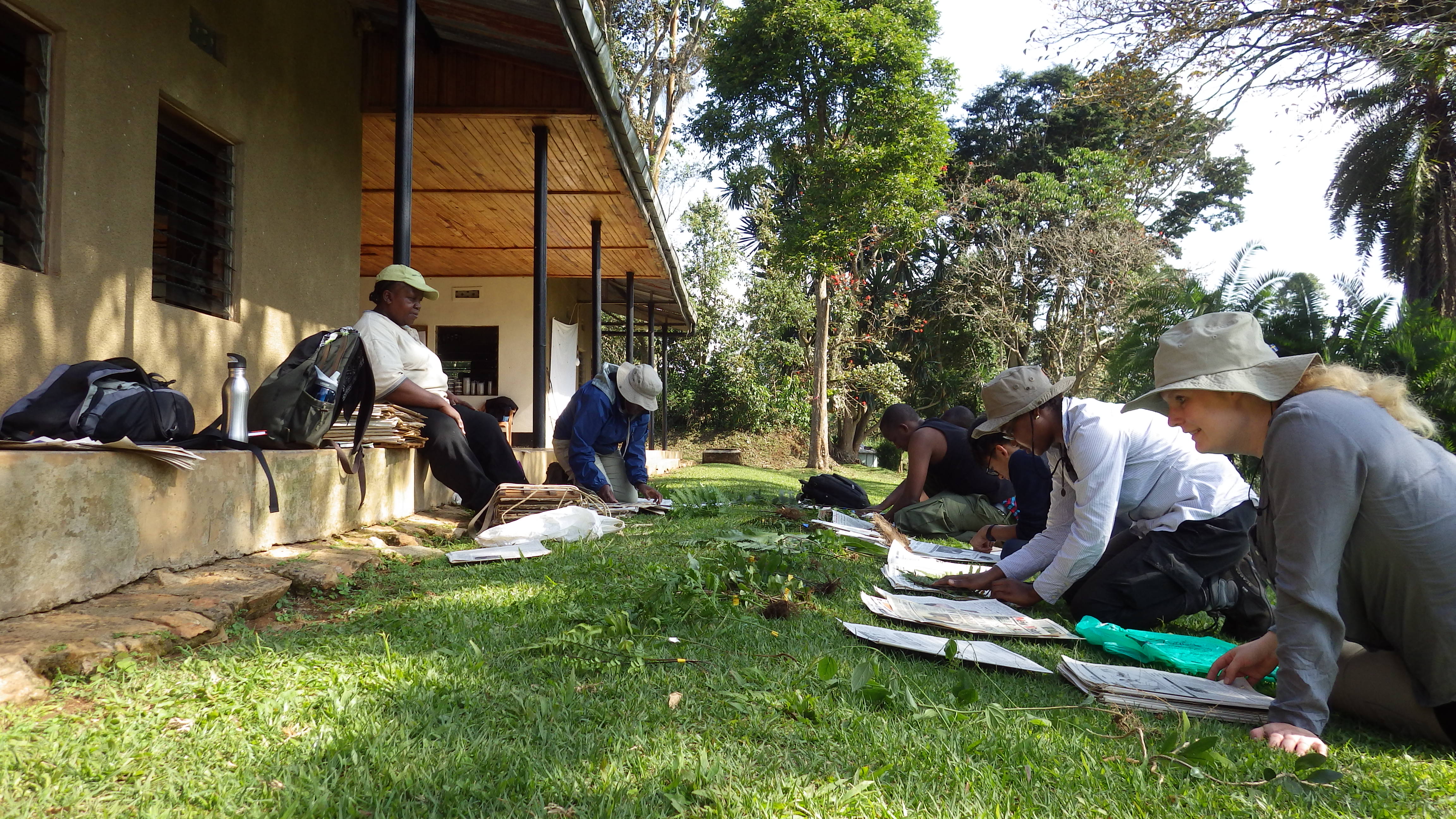
Dr Rose Badaza, a pteridophyte taxonomist, was leading a group of students to learn basic fern identification. Despite her short stature she’s a formidable personality with an air of command.

It’s often difficult to engage students in plants when their primary interest is animals; they’re so easily distracted. At one point one of the students picked up a frog, eliciting the usual cooing from the group, who all clustered round. Rose was unimpressed. Her eyes swelled and her lip trembled in mock apoplexy. “Put that frog down!”, she declared, turning heads within a five mile radius. “We are botanists. The frog is our enemy.” Duly chastened, the student gently released his prize.

The students present their tributes to Rose for inspection.

The students present their trophies to Rose for inspection.


With some downtime this afternoon I took a stroll through the home gardens in the village adjacent to the forest reserve. As I rambled along, familar small shapes darted through the bananas just out of sight, calling out “Msungu! Msungu!” and the occasional “How are you!”, though too shy to wait for a response.

As I turned to head back, one bolder child stepped out and beckoned me to follow. Approaching a hut just off the trail, a gaggle of children emerged, and all became clear. They had run home to smear their faces with white chalk, and were now excitedly dancing up and down, pointing at themselves and chanting “Msungu! Msungu!” with broad smiles on their faces. These days blacking up is considered terribly offensive. But whiting up? I’m fine with that.

Imitation is the sincerest form of flattery.

Imitation is the sincerest form of flattery.


One of the great nuisances here at the field station are the olive baboons, which prowl the compound in amongst the chalets, waiting to seize any chance to break in and help themselves to whatever foodstuffs they can find. The windows are barred but constant vigilance is essential. We have been warned of many occasions when they have discovered an overlooked entry point and wreaked havoc within.

Returning to my chalet this evening I found, carefully deposited on my doorstep, a partly-gnawed avocado, while a cluster of baboons sat at some remove watching my response. How should I treat this — as a peace offering? A gift? Is reciprocal altruism expected? I stepped over the abandoned fruit, then closed and bolted the door behind me. The avocado has since vanished along with the baboons. I fear that my insult will not go unpunished.


Butterfly ecologist Dr Perpetra Akite demonstrates her unusual collecting technique.

Butterfly ecologist Dr Perpetra Akite demonstrates her unusual collecting technique.


Field Notes from Uganda 1

I’m in Uganda this August teaching on a Tropical Biology Association field course. The idea is to bring together an international group of graduate students, an equal mix of Africans and (mostly) Europeans, which creates a real melting pot of backgrounds. Over intermittent blog posts I’ll be recording observations as we go along *.


On arrival in Entebbe I went for a wander in amongst the homesteads by Lake Victoria. With a longstanding interest in agroforestry, I’m always intrigued to see what people are growing. Down near the shore, goats were being harried amongst cassava, sago and other familiar crops. It’s always reassuring to see the same types of cultivation all across the tropics. As I turned one corner a man pushing a bike arraigned me. “Ah!” he exclaimed, apropos of nothing, “Finally you’re here!”. I responded gnomically in kind and continued.

A little further on I spotted some more interesting plants — indian rubber, a few Cecropias, exotic figs — and decided to investigate. The track widened and suddenly I found myself in an area with a diverse range of large, widely-spaced trees, and trimmed lawns between them. Puzzled but distracted by the trees I passed a nursery and headed inside to look around. There was a fantastic jumble of plants of all forms packed into overflowing shadehouses. I introduced myself to the women working there and discussed what they were growing.

After a little while I asked one of them what this place was. She looked at me with benevolent disdain. “It is a nursery”. I made a more expansive gesture, indicating the wider area. Her expression became more quizzical. “What do you mean? You don’t know?” I pulled my best baffled msungu look and waited. There was an animated conversation in swahili and much laughter. Finally she turned back to me and said “It is the botanical gardens!”


It’s not many years since there were bombings in Kampala, which means a robust security presence everywhere, even if their attentions are not necessarily strict. In the wake of the Nairobi shootings, shopping centres are seen as a potential target, and everyone is checked on entry. Mirrors are held under vehicles to check for bombs, while large signs demand that shoppers surrender their weapons at the gate.

My collegue Johan, a large animal ecologist, went to the local supermarket to collect a few essentials. On entry his bag was given the usual inspection, a little less cursory than usual as it contained several intriguing items of field equipment. One of the guards took particular interest in the binoculars, removing them and staring through them intently. “Are you checking that they’re really binoculars?” Johan asked, a little impatiently.

“No” replied the distracted guard, still pressing them to his face. “I want to look at that girl over there.”


A road sign: ‘Dangerous School Ahead’.


Driving across Uganda from Entebbe to Kibale provided an opportunity to get a measure of the country. Not so much from a landscape perspective, since everything near a major highway tends to be badly degraded, but a more nebulous feel for the prevailing mood. We all have our own points of reference though, which dictate our experience of a new country.

A colleague from Zimbabwe was particularly impressed with the general level of activity. The shops along the roadside are full of goods and a healthy commercial bustle. The roads are busy with well-kept vehicles. There was no sign of the groups of listless, loitering men that are a symptom of economic stagnation. Everyone had an industrious air and a sense of purpose. Moreover, he noted how healthy everyone looked, and rightly so. This was not only true in the suburbs of Kampala, where one might expect a thriving urban population, but out into the rural areas. This is not to blithely suggest that Uganda has no health problems, but rather that the visible signs are of a thriving populace.

My impressions differed somewhat because my comparator is elsewhere. I can’t help but contrast it with Southeast Asia, and what struck me is how similar everything looks to the way Malaysia and Indonesia were about 15 years ago. I was delighted by the hand-painted advertisements on the sides of houses, now a rare sight in SEA. The densely packed, road-facing lines of shops are also increasingly being replaced by centralised commercial districts. All this I say not as a critique, but in a spirit of optimism. I’ve witnessed the rapid transformation in SEA this century and there is every sign that Uganda is travelling in the same direction. What this will mean for the forests — that’s another story.


* No photos I’m afraid. The internet is far too weak. I might add pictures at a later date.

We’re all stupid to someone

I spend an increasing proportion of my time collaborating with engineers and theoretical physicists. It keeps me on my toes and I’ve had to adjust to very different research cultures. The engineers, for example, get particularly excited by designing a technical solution to a problem. The long haul of data collection and statistical analysis has less appeal; once they’ve proven it can be done then they’re itching to move on to the next challenge. Likewise physicists genuinely do spend meetings in front of whiteboards sketching equations, which leaves me feeling a bit frazzled. Nevertheless, I’ve learnt that if an idea can’t be expressed mathematically then it hasn’t been properly defined. That turns out to apply to a lot of verbal models in ecology.

Both engineers and physicists are ready to publish at an earlier stage than most ecologists would, and their papers are a model of efficiency in preparation. Not for them a lengthy waffle of an introduction, followed by an even more prolonged and rambling discussion. Cut to the point, make it clearly, then wrap up. It makes me wonder whether we’re doing something wrong in ecology. I certainly don’t enjoy either reading or writing long papers, and I can’t fully justify our practice.

I also find myself fielding questions or tackling issues that would never come up when chatting to an ecologist. One of the misapprehensions I’ve had to counter is that trees are not lollipops. It might be more computationally efficient to assume that trees are spheres of leaves on a stick, and it can lead to some elegant mathematical solutions, but the outcomes are going to depart from natural systems pretty rapidly. Our disciplinary training leads us to consider particular assumptions to be perfectly reasonable, despite them sounding ridiculous to others or bearing little resemblance to the real world. (Even within their own field, forest ecologists are not immune to this syndrome).

Understanding how another researcher arrived at their assumptions can be informative — sometimes it boils down to analytical frameworks, computational efficiency or technological limitations, all of which are valid reasons to consider accepting a proposition that on first hearing might sound far-fetched. Likewise it helps to have our own assumptions challenged. Sometimes we are able to justify and defend them. Other times they leave us exposed, which is when we know we’re onto something important.

It’s also a sad but common trait within all social groups to mock outsiders for making mistakes about things that appear self-evident to those on the inside. Ecologists can easily play the same game, but make no friends by doing so. I had a chat with one of my collaborators this week who was itching to find a small tree on campus, scan it using ground-based LiDAR, then strip and record the sizes of all its leaves. It’s a perfectly reasonable idea (if a lot of hard work). The main stumbling block is that it’s the middle of February and we’re a good three months at least from having full leaf canopies to play with. An obvious problem? Only to someone who spends their life thinking about trees the whole time. We had a laugh about it then moved back to our simulations, which have the considerable benefit of not shedding their leaves seasonally.

This kind of interaction only makes me wonder what crazy things I’m responsible for coming out with in our meetings. It also makes me grateful to my collaborators for their patience in humouring me, because I’m pretty sure that I come across as an idiot more often than I realise. This to me is the greatest pleasure of interdisciplinary collaborations. We could all spend the rest of our careers treading the same academic paths, publishing in the same journals, and not need to stretch ourselves quite as far. By heading way outside our comfort zones we all end up learning more than we expected to, so long as we don’t mind feeling stupid every now and again (which happens every time I get tangled in algebra). If you’re not willing to be wrong then you’re not willing to learn. And if I end up the subject of an amusing anecdote at a theoretical physics meeting? That’s fine by me. I hope it raises a good laugh. As a wise man once said, ridicule is nothing to be scared of.

The Law of Good Enough (or why your thesis will never be finished)

I spent quite a bit of time recently meeting our section’s post-graduate students for tutorials. In some cases this is to welcome new arrivals, or to catch up on progress from those who have been away on lengthy field seasons. The ones I most enjoy seeing are those  who are busy writing up — because they’re the ones I’m most able to help.

It can be difficult to persuade a postgrad staring down their thesis deadline that 15 minutes in my office is time well spent, which I fully understand. Usually they are stressed, feeling the pressure and unable to focus on anything other than the thesis. Much of this derives from a sentiment I hear echoed again and again in various forms: “I just want to do the best job I can”.

No. Stop. This is not the way to approach a thesis. You need your thesis to be good enough.

This shift in attitude is hard to accomplish when your whole academic career has been geared towards achieving the highest mark possible, or at the end of four years when you want to have something on your shelf to be proud of, that you can look at and think “I wrote that” and feel a warm glow inside. Allowing yourself to fall into this vanity trap is pathological, and the root cause of a lot of unnecessary stress on the part of post-graduates.

Your thesis is the means to an end, which is graduation. When the day comes, you will walk across a stage for 20 seconds, shake someone’s hand, collect a piece of paper and get a photo taken in a silly gown. It doesn’t matter if you’ve written the most perlucid, inspiring and impressive thesis of all time. No-one will clap any louder, or any longer. No-one will ever judge you on the quality of that thesis, good or bad. All that matters is that it was good enough.

In one of the labs I worked in we had a thesis that did the rounds of the post-graduates who were writing up. You might think that they were sharing a particularly wonderful thesis so as to learn best practice and be inspired by the achievements of others. I’m sure all the supervisors would have preferred that. But no, the thesis everyone wanted to see was singularly atrocious. No-one reading it could fail to spot glaring errors, hideous formatting and some of the worst figures ever committed to print. That’s exactly why everyone was so keen to read it — if this person passed then surely there was hope for others!

I’m not going to reveal whose thesis it was, because that doesn’t matter. They have gone on to a successful academic career where they are respected in their field with an international profile. Does anyone care that they submitted a shoddy thesis? Of course not. It was good enough. On the other hand, the best thesis I ever read remains that by Mike Shanahan, who preceded me by a couple of years and even worked at the same desk. Nothing could be more demoralising than to witness a standard of writing to which I had no hope of aspiring (at the time). Perhaps he still looks with satisfaction upon that thesis. He might do so again if he reads this. My bet is that it hasn’t crossed his mind in a decade or more. Did it benefit his career? Maybe, but probably not that much.

There is an argument that a better thesis will lead to an easier viva, and that’s perhaps the case, but my suspicion is that the correlation is not strong. How a viva goes depends on the personality of the examiners, their particular bugbears, the wind direction and the alignment of the stars. You can no more predict the questions than you can anticipate how many corrections you’re likely to get. The time to be a perfectionist, or at least to aim for the highest standards you can, is when you’re preparing a manuscript for publication. Then you know it’s going to be pored over in great detail. A publication is your contribution to the legacy of science, a work that will be forever associated with you. The thesis? That’s a bookend.

The best advice I ever received while writing up was from another old hand in the group who told me that a thesis is never finished. Eventually you just relinquish it to the examiners. Bear this in mind if you’re tempted to read and reread chapters, add more references, or tinker endlessly with the figures. There’s always something else you could do. Just get it done, make sure it’s good enough, then move on to the rest of your career.

—————————

Edit: @ZarahPattison made an interesting point on Twitter about thesis by publication. Although this is arguably the best possible way to prepare a thesis, it’s not for everyone, and many universities don’t even allow it. I wouldn’t like to give any student the idea that it was an expectation, not least because I didn’t manage it myself. It’s certainly true that a well-written chapter is easier to turn into a manuscript, but that’s missing the point. If you want to write a manuscript, write a manuscript. If you have a manuscript then turning it into a chapter is easy. If you need to finish a thesis then get the chapters done and worry about the manuscripts later.

Nottingham Forest go global

China recently released their global land cover map online, for anyone to view and download. It presents land cover at 30 m resolution, far superior to any previous map. It’s a brilliant achievement and provides data that up until now has only been available at great expense and could only be viewed with specialist tools. I’ve been having fun browsing it to find study sites and favourite places.

There’s something a little strange about it though. Look closely at the logo representing forests, then imagine the scene in the National Geomatics Center of China.

A: Let’s release our global land cover map to the world to display the glory of Chinese science!
B: We should add nice cartoons to illustrate each cover type.
A: Who will design those?
B: Don’t worry, we’ll just do a Google search and take the first thing that comes up.

And so it was that they came to represent forests using the logo of Nottingham Forest Football Club. Either that or someone at CAS is a secret fan of English lower-league football. Truly bizarre.

How to respond to referees’ comments

The first time I submitted a manuscript, it came back months later with a lengthy list of recommended changes and an equivocal response from the editor which implied that he was reluctant to hear from me again but might deign to respond if I proved myself worthy. I was devastated. It had been an immense amount of work and effort to prepare, and by now I’d moved on to other things. I glumly sloped into my supervisor’s office and was taken aback by his enthusiasm. Apparently this was what passed as good news in science *.

Since then I’ve been through the manuscript submission mill many times and always prepare my students in advance for the likely tone of what they will receive. It doesn’t get any easier. I still can’t read comments as soon as they arrive. Normally I’ll read what the editor says, skim the rest, then go for a short walk around the lake to calm down. Sometimes it takes several laps.

Eventually, however, you need to brace yourself and get down to the revisions. Clear your diary, close the door, unplug the phone (and the internet) and make sure there are no distractions. Don’t leave until it’s done. Unpleasant jobs are always the easiest ones to procrastinate from, and revising a manuscript comes pretty low on my list of favourite ways to spend an afternoon.

Assuming you have an invited resubmission (rather than an outright rejection **), here is a quick guide to how to respond to manuscript reviews that I wrote for my PhD students:

  1. Write back to the editor immediately, thanking them and the referees for their time and helpful comments. Even if you’re not grateful and they weren’t helpful. Even if they rejected the manuscript ***. Being nice works wonders in the long term because they will see your work again. They have also taken their own limited time, usually unpaid, to look at what you’ve submitted.
  2. Compose a response letter, starting in much the same way. List and address every single comment made by the editor and referees sequentially and in full. Keep in the positive ones too, it makes you feel better.
  3. Make it as easy as possible for the editor to tell that you’ve made the changes requested. This means that instead of saying ‘This has been done’, or ‘A paragraph on this has been added to the discussion’, say ‘This is a very helpful comment. We have therefore inserted a new paragraph in lines 283–292 which explains how…’ etc. Editors are busy and don’t like to have to work harder to check whether you’ve followed instructions.
  4. Tread carefully if you disagree with any comment. If it makes no material difference then make the change, even if it’s only a matter of preference. Only contest if you are convinced that the referee is wrong and you can back it up. Even so, apologise for not making the manuscript clear enough and specify where you have added clarifications or extra evidence in the text. If you’ve failed to convince them first time around then it implies that you need to change something.
  5. Try not to use track changes, comments, bold type or other formatting to note changes to the manuscript itself. In my experience (usually when requested to by editors…) this leads to errors in the final copy. Refer to line numbers instead.
  6. Take extra time on the figures. Clear, high-quality figures give your paper a greater chance of being read, cited and used by others. If the figures look amateur then no-one will bother reading the text. Use this opportunity to redraw and tweak them using proper tools (e.g. inkscape, sK1, ImageMagick, gimp). Don’t rely on Microsoft Office products to create publication-quality images.
  7. Never play referees off against each other. If they disagree on a point then compromise and ask the editor for guidance. Also note that if only one referee picks up on something, this does not imply that all the others are on your side. They may simply not have noticed.

Finally, in almost all cases reviewers are doing it because they genuinely care about maintaining standards in the scientific literature and improving the quality of work that gets published. There are some cases when a reviewer might block something too close to their own work, which contradicts them, or out of some personal vendetta against you or your collaborators. This is exceptionally rare though, and can seldom be demonstrated. Even if you suspect it, you’re most likely wrong, and should never say so in your response. No-one is out to thwart you.

Good luck, and remember, we all go through this. If it starts to get you down then go and vent to a colleague. Everyone has stories to share.

————————————————————————————————————————————–

* A friend at a university in a developing country once related that the modal number of papers among his faculty colleagues was zero. Exploring the causes of this, it transpired that in many cases they had once submitted something to an international journal and been so offended by the audacity of the response that they had vowed to never subject themselves to such humiliation again. This was true of even senior professors.

** I would recommend doing all this even if you’ve been rejected. Partly because you have a high risk of coming across the same referees again at a different journal, but mainly because it forces you to confront the criticisms of your work.

*** Don’t contest a rejection unless one of two things apply. Either there has been a gross mistake made by one of the referees, and you can unequivocably demonstrate this. Or you’re submitting to one of the big journals (Nature, Science) when putting up a fight can make a difference. Apparently. It’s never worked for me.

Beyond ash dieback

Towards the end of last week the phone started ringing. I’d been expecting this for some time. The news had just come through that ash dieback had been discovered in Nottinghamshire, not far down the road from my office. This is something I had anticipated several years ago, though I make no claim of special prophetic gifts. It was obvious that it would. The disease has spread systematically from the east of Europe, sweeping unimpeded right the way to Holland (see the Forestry Commission website for an excellent summary of the disease and its background). It was only a matter of time before it made it to the UK, and once established there was no keeping it from Nottinghamshire. This despite the British government convening a meeting of COBRA, the national emergencies committee, in an effort to be seen to be Doing Something. They might as well have objected to clouds.

The reason I was suddenly being called was the estimate by Nottinghamshire County Council that 40,000 trees might need to be removed in the next five years. As ever, journalists settle on the story first then try to find some talking heads to fill in piece with some choice quotes. In every phone conversation it quickly became clear that they wanted me to say how terrible this was so that they could set up a conflict with the Council’s plan. “Academic says save our trees!” All of them finished the conversation disappointed with my failure to play the game.

This culminated in an appearance on Notts TV alongside a friend from Notts Wildlife Trust in which they were hopeful that one of us would bite. The trouble is, we both agreed. The actual numbers are an estimate, and not worth fighting over, but the basic principle remains. Trees are going to have to be cut down.

Why am I so willing to accept this drastic intervention? The simple truth is that most of these trees are going to die anyway; the Danish experience suggests as many as 90% will eventually succumb to the disease. Most of these have been planted, often from commercial (and frequently non-native) stock. Ash is favoured as a screening tree along roadsides and around developments because it grows tall and fast. Not all trees are equal, and a young planted ash tree ranks pretty low in terms of its conservation value, relative to say an ancient yew or a small-leaved lime. Trees that are sick and dying are not merely an eyesore, they’re a risk, especially along roadsides, paths and bridleways. Land owners would be legally liable if they fell on someone. The Council is being perfectly sensible and their press release was simply preparing people for the worst.

While some have capitalised on the flurry of interest by launching projects to characterise the ash genome or develop resistant trees, these aren’t going to make a difference in even the medium term. I can’t blame people for using a news story to get some research funding, but these are not solutions to the problem. The trees are going to go, and the landscape of the UK will be changed for at least a generation.

The issue that really matters is what we choose to do next. Where ash trees succumb on private land or in closed woodlands, they should be left alone to die and fall. This will create a large resource of dead wood which will benefit a wide range of species, especially insects and the birds which feed on them. Where large trees fall, they will create gaps in forests that other species will benefit from. There are many woods (particularly here in Nottinghamshire) that only exist because ash colonised abandoned fields following WW2 when marginal land was pressed into production. These are now 70 years old and have plentiful seedlings beneath them — oak, field maple, hazel, wych elm — all of which will grow to fill the place of the missing ash. Our woodlands will change, but nature is dynamic and ceaseless change is a rule. Their composition was never natural in the first place (if natural is taken to mean wild and unaffected by human influence), so it’s hard to make a case for their preservation or restoration. Let’s see what happens. It’ll be interesting.

In urban areas, people appreciate the presence of trees, and will miss the ash when they are gone. The question we should be asking is: what will we plant in their place? Instead of introduced species (e.g. London plane, which isn’t from London at all) or those which offer little to wildlife (e.g. whitebeam), why not take a longer-term approach and plant a variety of native species that will bring more wildlife into our towns along with variety and interest? What would you like your grandchildren to be walking under in a century’s time — another monocultural row of ash, or a lane of oak, beech, hornbeam, lime and black poplar? The death of our ash trees will leave a gap in our landscape. But any gap is also an opportunity.