Tag Archives: conservation

How I stopped believing in the biodiversity-ecosystem functioning consensus

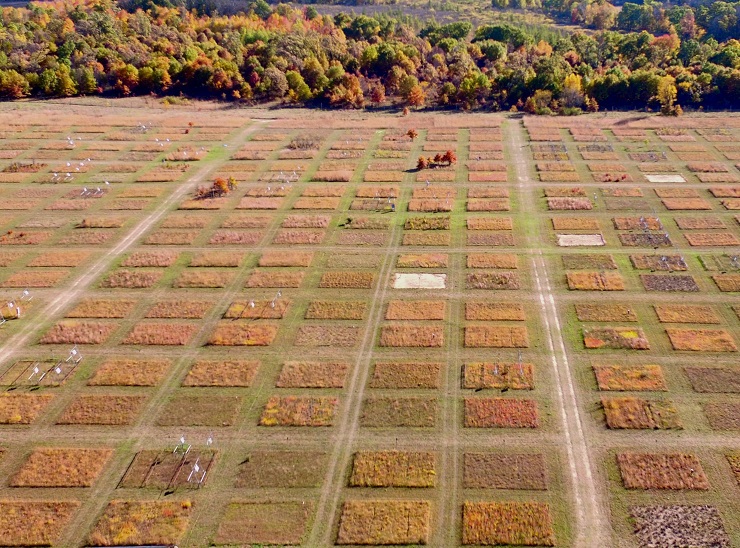
The E120 Biodiversity Experiment at Cedar Creek in Minnesota, from their website.

It all began with the best of intentions. By the time the Millennium Ecosystem Assessment was published in 2005, there was already strong evidence that the services nature provided to humanity were in decline, and our degradation and over-exploitation of nature was to blame. We were also acutely aware of rising extinction rates, and biodiversity had long been a cause around which world leaders were prepared to rally.

The missing piece of the puzzle appeared to be obvious: show that biodiversity was good for ecosystem functions and services, and the case for conservation could add raw self-interest to the mix. This was the foundation for thousands of studies of the biodiversity-ecosystem functioning relationship (often shortened to BEF).

In practice biodiversity was usually translated into species richness. This is of course reductive, but then species richness is often assumed to capture many other aspects of diversity, including traits, phylogeny, resource use and much more. This assumption is seldom directly tested for the set of species under study. Nevertheless it seemed to work. Early evidence of positive effects of species richness from sealed laboratory systems had been replicated in some the most ambitious field experiments in ecology, resulting in countless papers and a growing confidence that more species were a universal good. It also appeared that one of the key benefits was multifunctionality, which meant that the more species you had, the more services they were able to deliver. Everyone came to agree that biodiversity was one of the most important forces shaping ecosystem function. There was even emerging evidence that real-world patterns might be stronger than those in experimental systems, which made sense because we expected ecosystems to be structured in a way that made the roles of species complementary.

Ten years ago I published a textbook with a chapter on why diversity matters which presented this consensus. Prior to publication I sent it to a few colleagues who were active in the BEF literature and they gave it the thumbs-up. Everyone was agreed: more species were always a good thing.

At the moment I’m revising the textbook and finding that the last decade has not been kind to the consensus view. Every bandwagon eventually attracts a backlash, so this is not unexpected, but it creates a challenge for how to effectively synthesise the literature and present a clear story that allows readers to understand and engage with the evidence as it emerges.

First, even after thousands of studies, there is still enormous bias in the evidence base behind BEF research. Most studies are of plants, the main ecosystem function measured is simple productivity, and they are geographically located mainly in temperate zones. The evidence from aquatic systems (marine or freshwater), the tropics or non-invertebrate animals is slight. We should always be cautious about declaring a general rule for which the evidence is not yet general.

Then there’s the problem that experimental results haven’t replicated in the real world. Early reviews were unequivocal: biodiversity was always good, all the time. More recent studies in natural systems have found that while positive effects outweigh negative ones, actually the majority of studies find no effect at all.

To this we can add emerging evidence of ecosystem disservices. There are certainly ways in which biodiversity can be harmful to humans. In some of my own research we found that increased tree cover around rural villages was linked to greater risks of disease by supporting vector populations. Likewise in agriculture, the whole history of intensification has been one of deliberately reducing diversity in fields to boost the necessary service of crop production.

There are also critiques of the ways in which previous studies analysed their data which suggest that they may have over-stated the benefits of biodiversity. While not wanting to get into the technical details, it’s at least worth noting that the fundamental nature of the relationship has come under scrutiny.

Finally, the emerging picture is that species richness isn’t always the main correlate of functioning. Sometimes functional or trait diversity turns out to be more important, and species richness is only an indirect or imperfect means of capturing this. This then leads to another set of questions for which ecological theory leaves us on unsteady ground. Which traits matter, and why? There is a danger of circular reasoning if we end up picking traits because they affect ecosystem functions (try them all and see which works), or because they’re the ones we’re able to measure, without putting a deductive framework in place first. We could end up just creating a new set of problems for the next generation of ecologists.

For some groups of organisms there are standard sets of traits, most notably the Leaf Economic Spectrum for plants, which has been joined by the Wood Economic Spectrum for woody plants and some other developing initiatives. There is a different problem here though, which is that we find that particular environments select for a relatively narrow range of traits. If for example only plants with certain traits can survive in the desert, and deserts have low productivity, is it the environment or the trait diversity that limits productivity? Most ecologists would vote for the former. The pathways of causation become complicated and we need to reflect on whether trait diversity is the cause or a side effect of ecosystem functioning.

Where does this leave us? Perhaps we shouldn’t have expected nature to do any favours for us. We certainly haven’t reciprocated. Quite simply, nature doesn’t care about us. There are interesting fundamental questions to be asked about what structural aspects of natural systems are connected to ecosystem processes, but these need to be addressed without the distorting lens of of activism. There are also plenty of ways to justify conservation of biodiversity without making claims for its benefits to people. We might eventually find ways in which maintaining high biodiversity can be reconciled with our own self-interest, but for now I’m stepping off the BEF bandwagon and waiting for the fog of evidence to clear.

Class exercises for teaching conservation biology

I’m in the midst of writing a new module in Conservation Biology. It’s quite exciting (and daunting) to start a course with an entirely blank slate. Finding material for the lectures is no problem because I’m following a standard textbook and there’s never a shortage of examples in the literature. It’s always more difficult to come up with class exercises though. These are crucial to engage students with the subject matter and get them to critically evaluate different positions, including their own.

This is the first time I’ve taught a whole module on the subject, but luckily there are many others who have trodden the same path before me, so I put out a call for ideas on Twitter:

As expected, this provoked an avalanche of brilliant ideas, all classroom-tested and ready to roll out. Rather than hoard them all, here’s a summary of the suggestions, several of which I’m already planning to deploy.

Unsurprisingly there are already resources out there, so before developing something on your own take a look at the online collections provided by @sesync, @CaseStudEnv, @BIOINTERACTIVE, @CBC_AMNH, National Center for Case Study Teaching in Science, CISV International (including one on deforestation in DR Congo), HNV Link on agroecosystems, as well as the discussion questions in many textbooks. Below are just the ones that were suggested directly.

A great idea which I had already stolen from @juliapgjones is to launch into the course by getting the students to take the Future of Conservation survey:

This is a great way to get students to explore their own attitudes and preconceptions at the outset, which provides a foundation for them to reflect on the material and their responses to it. There’s even a GO-FOX tool which allows you to carry out bespoke surveys for closed groups, allowing students to compare their opinions to the rest of the class. Even if you’re an experienced conservation practitioner I recommend you to do the test; it’s very revealing.

One of the oldest arguments in conservation biology is the SLOSS debate over reserve design (Single Large Or Several Small). I admit to being a little weary of this one based on the simple observation that such abstract, idealised concepts almost never play out in reality. Nevertheless, as an exercise in discussing where our priorities should lie, this is a nice self-contained topic to work on. For example, students could be given a hypothetical landscape and invited to discuss how to distribute a limited reserve area within it. @LauraEllenDee has a jigsaw exercise based on her recent paper which covers this material nicely.

A related issue, and perhaps closer to what happens on the ground, is to look at the tension between land sharing and sparing:

Biodiversity trade-offs are another great opportunity to turn into a game. Having known @jlsnaddon for some time, it doesn’t surprise me that he’s found a way to transform this simple idea into something that looks professionally designed:

Another fun game comes from this set of notes for a class on the Tragedy of the Commons, which @CarlaWildlife has adapted using Skittles. She also has more suggestions:

One way to take conservation strategy away from abstract considerations is to use real-world case studies. Students can be invited to choose sites worldwide, download species lists, calculate EDGE scores or other biodiversity metrics, and identify possible actions or priorities in either a poster or talk. It sounds as though there’s an interesting publication coming up which does exactly this:

A number of people recommended roleplay exercises as a great way to explore the different sides of complex debates in conservation. Students often get so involved in the discussion that this becomes quite heated. Not unlike the real world. A great one to whet the appetite is the issue of feral cats, with some good evidence of impacts on piping plovers. The harvesting of sea turtle eggs is another. You could raise the stakes by turning it into a shark tank dynamic (which I think is the same as a balloon debate). You can even get a good argument out of students by looking out of the window and asking about the differences in conservation value between a lawn and an unmanaged patch.

Another topic with a well-established body of conservation theory is Population Viability Analysis, and here again students can try out the calculations for themselves (I imagine this is often quite sobering):

https://twitter.com/Dr_Stoat/status/1159010240236544000

Debates are also an important tool. For example:

This sounds like a great question. I’m wary of setting quite so much compulsory reading, although Feral and Rambunctious Garden sound very provocative and I should probably read them myself.

Other common tools are online quizzes followed by class discussion (Mentimeter is a recommended tool), showing or making students create videos, or getting them to develop their own case studies which they can present back to the class:

Finally, I’m intrigued by a suggestion from @Tarsiussallius of bringing in some Citizen Science element; I’ll have to think more about how to achieve that (and would love to hear from anyone who has done this).

This post is a work in progress and I’d welcome any other suggestions or feedback based on class experience. If you have a great exercise (or know of one) then why not nominate it for the Case Studies in the Environment Prize? Fame, glory and $2000 could be yours.


Thanks for input on this post (in order of their replies in the original thread) to @ecoevoenviro, @Jungle_Lou, @bonebraking, @Honor_Prentice, @juliapgjones, @bangorherps, @EntoProf, @SaraScanga, @LauraEllenDee, @jlsnaddon, @ja_tobias, @LaMontagneLab, @Zen_of_Science, @mceuen_amy, @Tarsiussallius, @KampJohannes, @OrnithoAle, @TraciInFinland, @_GeorgeHolmes, @josephjbailey, @Dr_Stoat, @KStackWhitney, @CaseStudEnv, @katiemattaini, @megcevans, @CarlaWildlife, @katzyna, @Rosie_Baillie_, @Xim_Neri, @yitarn. If you’re looking for an inspiring set of conservation educators on Twitter then follow all of them.


Remembering rhinos

20190527_104731

Is this how we will remember the rhinos? Will it be any better than Dürer’s rhinocerus?

This autumn I will be teaching a new module in Conservation Biology. There’s a lecture I’m already writing in my head, though I dread the day that it finally happens because it comes with a personal dimension. I must be among a small number of living witnesses to two species which are now on the verge of extinction.

This week we learnt that Tam, the last male Sumatran rhino in Malaysia, has died. I met Tam while working in Borneo many years ago. My home was close to an institute that was attempting to breed rhinos and I would regularly walk past the enclosure hosting these recalcitrant giants on my way into the forest.

The story of the rhinos of Sabah is tied up with political disagreements, human tragedy* and some extremely bad luck. For many years it was asserted that there were 30 left in the wild, despite a persistent absence of evidence. Now we have to admit that they are on their way out. And no, I don’t have much hope for expensive lab-based interventions. If the habitat they lived in has gone, along with the accumulated knowledge and experience that allowed herds to move and forage through the landscape, then the species can only return as a curio. Limited conservation funding is better directed elsewhere.

By coincidence I also met one of the last of the northern white rhinos while teaching on a field course in Kenya 15 years ago. Not the very last, though this hardly matters, because their trajectory was already dismal. It lumbered peaceably around a bush and came directly towards me, staring directly down the barrel of my camera lens. Sadly I have no evidence of this because the film was subsequently ruined**, but I don’t need the photograph. The moment is seared in my memory for life.

In both cases I encountered the rhinos in sad circumstances. Tam was so domesticated by human contact that he was more interested in having a belly rub than in demonstrating his physical strength. He certainly wasn’t much interested in sex with other rhinos, which was the preoccupation of his keepers. The northern white rhino I met was accompanied at all times by a pair of armed guards. In neither case could I claim to have seen the species in its full glory. They were docile, amiable memories of rhinos.

These are the only rhinos I have seen outside zoos, although their absence is tangible in the increasing abundance of Euphorbia candelabrum in African savannahs, a generally unpalatable species but one which rhinos formerly consumed. Losing such a major herbivore inevitably has impacts on plant communities as well. If you know where to look then there is a rhino-shaped hole.

Yet my world is full of rhinos at the moment. My son plays with a plush cuddly rhino, has a soft blanket with a rhino print, wears a t-shirt covered with cartoon rhinos. The same could be said of dinosaurs, and what rhinos share in common is that they are large, charismatic megafauna which he will probably never see in the wild.

Yes, I know that there are positive stories to tell in rhino conservation. Global rhino numbers across all five species are close to 30,000, mainly due to successful protection of the southern white rhino in South Africa, but still the two Asian species hover on the brink, and a new poaching epidemic threatens recent gains.

And so, later this year, I will stand in front of a classroom of students and bear witness to the losses of my generation. We knew this was happening, we watched it happen, we tried to raise the alarm but our voices were not enough. The pressure is now building through movements like Extinction Rebellion and the realisation that this is an emergency. I hope that the tide is turning. Much remains to be saved. But even if we succeed this time, one day we will be forced to look back and see how much we have lost, plants and animals alike. I hope that I never have to describe a rhino.

The_Rhinoceros_(NGA_1964.8.697)_enhanced

Albrecht Dürer‘s famous 1515 print of a rhinocerus. It was drawn based on a written description of a rhino in Lisbon; Dürer himself never saw one. This fantastical image of a rhino nevertheless became wildly popular and shaped European imaginations of what a rhino looked like for centuries thereafter. Will our grandchildren know any better?


* My memories of the Sumatran rhino will also be tinged with sadness in recollection of the brilliant Dr Annelisa Kilbourn, a wildlife vet who died tragically in a plane crash in Gabon in 2002. Best known for her brave work demonstrating the link between gorillas and ebola, the rhino project was another large gap she left behind.

** At this point I might need to explain to the students that cameras used to contain film, before the arrival of digital mechanisms of capturing and storing images. This will only make me sound like even more of a dinosaur.

Should we eat Bambi?


Fallow_deer_arp.jpg

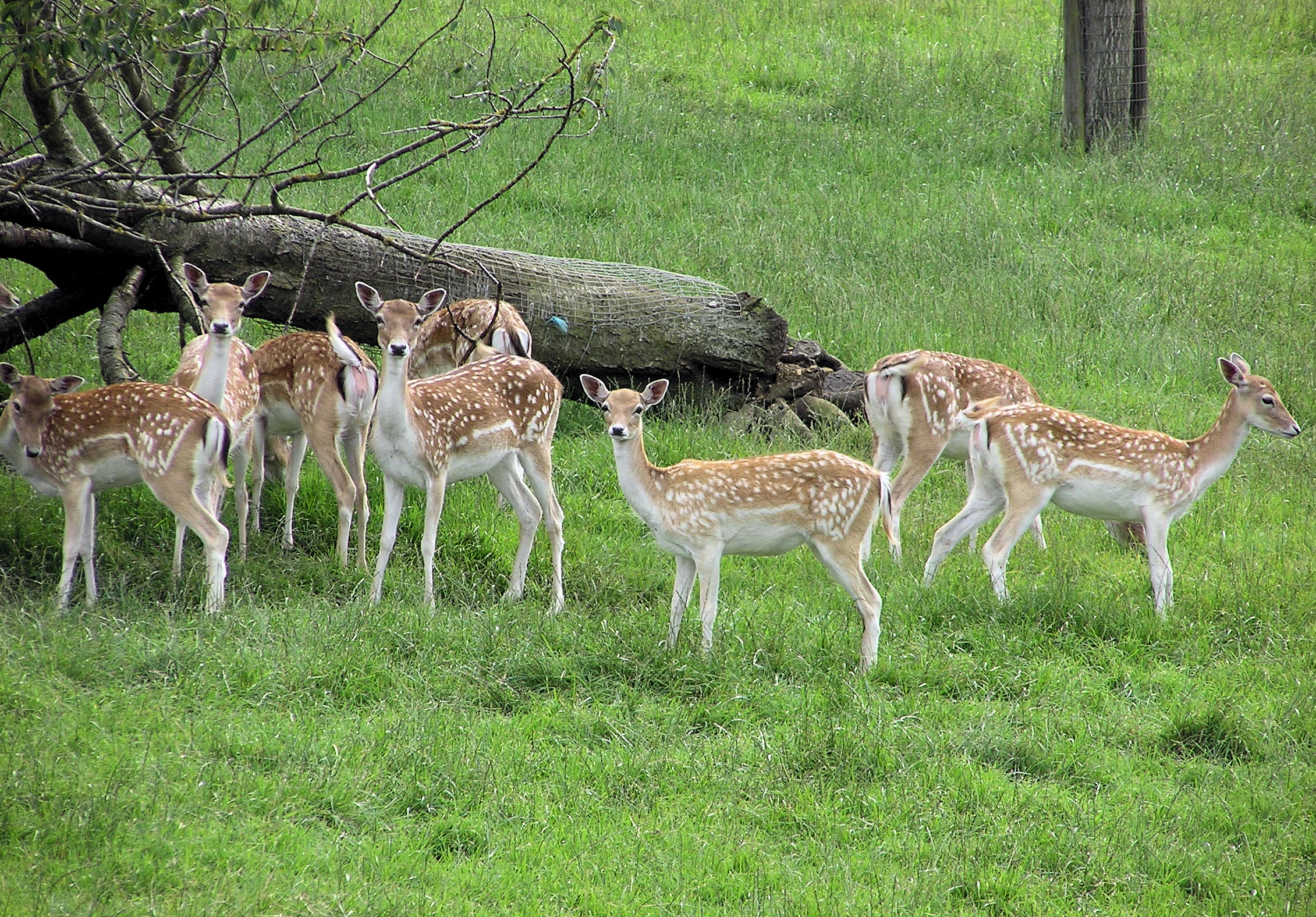
Fallow deer in Avon Valley Country Park, Bristol, UK. By Adrian Pingstone (Own work) [Public domain], via Wikimedia Commons. Note that deer kept in parks are not part of the problem; this just happens to be a nice picture of them. Leave these deer alone.

 Our new paper has just come out in Journal of Applied Ecology, in which we’ve used terrestrial laser scanning to examine the three-dimensional structure of 40 lowland British woodlands. We compared woodlands in areas with high and low deer densities, and which were either managed or unmanaged. One of the main findings will surprise no-one: in areas with lots of deer, there is much less foliage at heights below 2 m. What makes our study unique is that we were able to quantify this as a 68% reduction. The interesting results don’t stop there though; there were other differences between high- and low-deer woodlands, extending right the way through the canopy. High-deer woods were on average 5 m taller for some as-yet-unknown reason.

In another post on the Journal of Applied Ecology blog I’ve described these findings in more detail and explained their specific implications for forest management. Here I’m going to use my own site to step over the line into more controversial territory and ask what this means for the broader issue of conservation policy. Note that these are my personal opinions, and go some way beyond what was said in the paper itself*.

First, there are vast numbers of deer in the UK. Their populations have boomed over the last century for a number of reasons. These include a lack of natural predators (wolves and lynx disappeared centuries ago) along with a range of other factors that might include an increase in woodland area, planting of over-wintering crops, and perhaps also impacts of milder winters on their survival. The UK is not alone in this; similar patterns have been observed elsewhere in Europe, throughout North America, and in Japan.

One of the features of the deer we find in British woodlands is that they are overwhelmingly made up of non-native, invasive species. In our study most (85%) were fallow deer, pictured above, which were introduced in the 11th century for sport hunting in deer parks. They are joined by Reeves’ muntjac, a small Asiatic species that probably escaped into the wild in the 19th century. It’s worth emphasising that I bear no grudges against the large, noble red deer of Scotland, nor the scarcer native roe deer, which we seldom detected in our surveys.

Our work has shown that in areas with high deer populations (more than 10 per square kilometre and often much higher) there is a loss of complex understorey vegetation. This dense ground-level foliage includes the regrowing seedlings and saplings of canopy trees, as well as providing habitat for a wide range of birds, small mammals and insects. That many woodland birds have been in decline over the last century is probably not coincidental, and consistent with patterns seen elsewhere in the world.

There are several options to keep deer out of woodlands, but most are either infeasible or ineffective. Fencing is an option, but it’s enormously expensive to establish and to maintain. Moreover, the longer a woodland is left without deer, the greater the amount of palatable foliage that will build up, and hence an ever-increasing incentive for deer to find their way in. It’s also difficult to keep small deer out while allowing passage to the other animals we would wish to have free movement around the countryside. For this reason fencing can only ever be a local and temporary option. Deterrents are also unlikely to be effective. Chemicals soon wash away, and deer quickly learn to ignore attempts to scare them. These tricks might work briefly but they won’t keep deer away for decades, which is what we need to do if we would like complex forest structures to develop.

What then can we do? Let’s tackle that thorny euphemism, ‘control’. What this almost invariably means is finding a way to reduce deer populations. In such circumstances  well-meaning people will always suggest sterilisation, although this would be prohibitively expensive to apply to many thousands of deer, and probably as stressful as any other action. The next option then is that most unpopular of conservation moves, a cull. These are still expensive to carry out and to maintain over long time periods, at least in open landscapes where deer can constantly wander in from elsewhere. What do we have left?

Venison_escalope

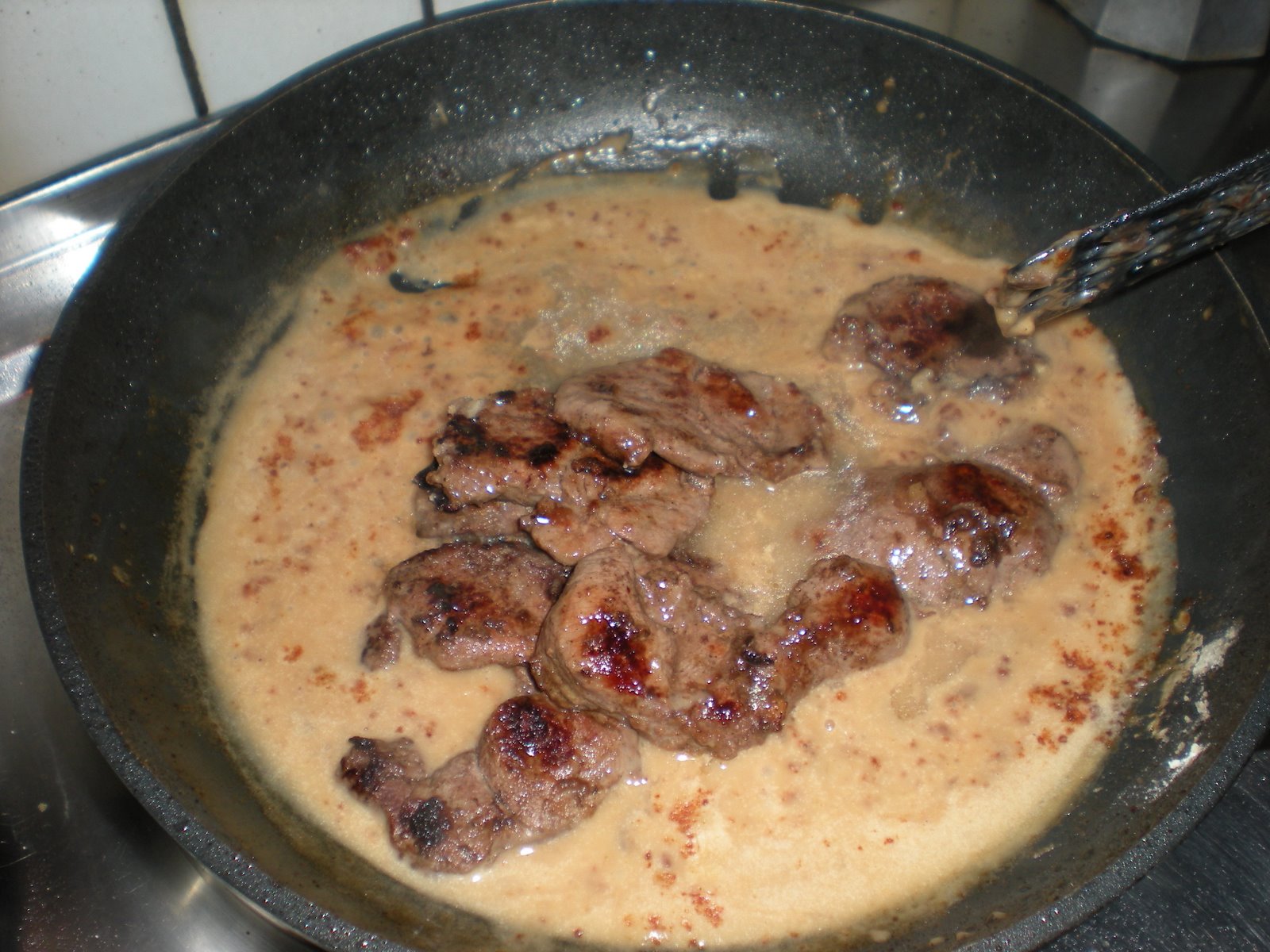
Venison escalope in Switzerland. By Kueued (Own work) CC BY-SA 4.0-3.0-2.5-2.0-1.0, via Wikimedia Commons. Serving suggestion only.

We can eat them. It’s almost the same as a cull, except the meat doesn’t go to waste, and the market would help fund deer control. Fallow deer were actually introduced to the UK by the Romans a thousand years before the Normans brought them here, but died out — probably because they were eaten. Together we can do it again.

Venison was a traditional meat eaten throughout the UK only a century ago, as it remains in many parts of Europe. If wild-caught, free-range British venison were to appear in our butchers, on supermarket shelves and restaurant menus, we would only be restoring it to its former popularity**.  Another benefit is that it would provide a source of income for rural communities, many of which are among the most deprived in the UK. The same approach could be taken with wild boar, though my suspicion is that this would not be as effective at controlling their populations***.

Will this work? Nothing in ecology (or life) can ever be guaranteed. When we intervene in complex systems there is always the chance — indeed the likelihood — of unforeseen consequences. The only way to guard against this is through careful monitoring and intervention. If the aim is to restore forest structures then we don’t yet know how low deer populations need to be brought down, over what time periods, and whether market forces will be successful in achieving this. What we do know for certain is the effect of doing nothing. If there’s a chance that eating deer might work then, if you’ll pardon the pun, it’s worth a shot. And venison is delicious.

Eichhorn M.P. , Ryding J., Smith M.J, Gill R.M.A , Siriwardena G.M. and Fuller R.J. (2016). Effects of deer on woodland structure revealed through terrestrial laser scanning. Journal of Applied Ecology, in press. DOI 10.1111/1365-2664.12902


* One of the reasons I’m writing this here, rather than in the paper itself or the journal blog, is that the authors of the original paper wouldn’t all necessarily agree with my prescription.

** In North America hunting is a popular rural pastime and, contrary to the perception of outsiders, has little to do with taking down large animals for display. The majority of people hunt for the table. Why then has this not led to effective control of deer populations? This is probably down to two factors. The first is the vast area of North America, much of which is wooded, and with low densities of people. The second is that game laws regulate hunting so as to maintain populations of deer (at least in part) rather than for the conservation benefits.

*** What we refer to as wild boar in the UK are actually a breed of pig. Although they have escaped and naturalised (and trash habitats in places like the Forest of Dean), when you buy wild boar sausages in the shops it doesn’t necessarily imply wild-caught boar. Most meat still comes from farms. The reason I don’t think we will control wild boar by hunting alone is that they breed at an incredibly fast rate, whereas deer populations grow much more slowly.