Tag Archives: PhD

How to write a PhD thesis. Part I: Saving Time

My aim in this series is to explain the things that are often in plain sight but not always to the person that most needs to know. Image by Randal Phoenix.

Amongst PhD students it’s unsurprising that the thesis becomes the subject of obsessive attention. The thesis is, after all, the one absolutely essential output of the program, the final product, the main focus of assessment. Everything else is nice-to-have but not actually required for graduation1.

There’s another point of view though, which is that the thesis is actually the least-important output you’ll produce. As soon as you’ve passed the viva it doesn’t matter. The chances are that no-one will ever read it again. The fact that you have a PhD implies that a thesis exists somewhere but your potential as a researcher will be measured in actual publications2. This is why, as I’ve argued elsewhere, the thesis only needs to be good enough to pass. It doesn’t have to be perfect. It’s not the defining statement of your career. You need a thesis; you don’t need a great thesis. Don’t create something that’s a joy to read when it’s only being sent to an audience of two people3.

This is why I counsel against the danger of thesis-gazing, which is when an inordinate of time is spent on trying to craft the perfect thesis for your own satisfaction rather than directing effort towards the parts that will actually count. Focus instead on the elements that will have an impact on your future career, the chances of an easier ride in the viva, and for the actual progress of your field as a whole. Crafting a thesis that flows in a cohesive narrative arc might be satisfying but it’s not necessary. A student who slings together a bunch of loosely-connected studies and sticks a cover on it, but who also gets several papers out at the same time, is going to have a better chance of landing a post-doc position. Your future employers will not read your thesis but they will read your CV and publication list.

The main idea I’d like to get across in this post, and the ones that follow, is the importance of marginal value. You have limited time, no matter what stage of your degree you’re at. Invest in the things that will make a difference now and in the future, and cut corners wherever you can get away with it. This will reduce the pressure you place on yourself.

Here are the three things you can probably save time on4:

  • Final discussion. Quite frankly, no-one cares about this. In this concluding chapter you aspire to draw all the threads of your various studies together. The aim is to convince the reader that it did all actually make sense, you found something worthwhile, and has wider importance and implications. The truth is that your examiners have already made their mind up by the time they reach the discussion. A great discussion will not rescue a thesis if the data chapters have been below par. Likewise a bad discussion isn’t going to change their minds, and if they don’t like it then they can ask for amendments. Most likely is that they will run out of time before the viva, give it a skim read, and not worry too much. Leave this until last and run it off in a couple of days (no more than a week).
  • Appendices. A thesis chapter is a manuscript that needs to go on a diet. Publishing it requires you to remove all the fat: supplementary analyses, digressions on individual observations, excessive literature citations and endless waffle. It’s already too long. Then there are the other things you did on top, which probably took a lot of time, but which don’t quite fit into the chapter. So you think: let’s have an appendix. This appears to be a cost-free solution. It will also have absolutely no impact on the quality of your thesis or the outcome of the viva. If there’s something you can’t bear to leave out then you could have an appendix. Or you could put it in a shoebox and bury it in a bog where it has a higher chance of being found. Time spent preparing and formatting the appendix is generally wasted.
  • Rants. You’ve spent a long time thinking about this one thing. It’s been your whole life for the last few years. In the course of this obsession you have developed Opinions. And someone needs to hear them. Whether it’s that a major paper in the field is wrong, or a method is flawed, you’re about to unleash. Unfortunately only two people will read it and the internal examiner won’t care. The external will either disagree, which creates a problem in the viva, or perhaps already agree. Maybe, in the best case scenario, you might actually change their mind. Fantastic! That’s a lot of effort to shift one person’s opinion, and probably not worth it. Write an angry blog post instead or start an argument on Bluesky.
  • General introduction. This one is likely to spark some disagreement from other academics because writing a general introduction is an essential step in the grad student journey. But if the point of the general introduction in the thesis is only to explain and justify your research questions then it doesn’t need to be highly polished. Put the real effort into the chapter introductions because there’s a good chance of those being turned into manuscripts. The counter argument is that the general introduction is the first thing examiners read and it’s worth giving them a good impression. I do agree with this. Make the introduction coherent and authoritative, but it’s not going to make-or-break your thesis. If you miss something out then your examiners will tell you and it’s an easy correction to make.

I’ve been direct supervisor for a dozen completed PhDs and acted as tutor or advisor to countless others. Every single one said that they want to publish their general introduction as a review paper. Maybe this is one of those post-grad myths because I’ve never seen it happen. Instead students can spend an inordinate amount of time crafting what amounts to a lengthy attempt to demonstrate that they’ve read (and cited) everything of potential relevance to their PhD. It’s good experience but look at it in terms of return on effort. I’ve examined theses with finely crafted introductions and made no comments on them at all, then given the students a hard time because their data chapters were sub-standard. I’ve also read theses with cursory introductions followed by a series of self-contained manuscripts. The latter had a much easier ride.

In my next post I’ll move onto the things that are often under-valued by many students, but where you can reinvest the time saved by decreasing emphasis on the above. Or just take the weekend off, you probably deserve it.


1 There are some countries where a publication, or at least a submitted manuscript, is required before the PhD can be awarded.

2 Or, depending on your field, software tools on GitHub, patents, new species, DNA sequences… all sorts of things that might be picked up and used by others. Unlike your thesis.

3 My experience is with theses in the UK and Ireland, and I know that there is variation between systems, but in all cases the likely audience for a thesis is in the low single figures.

4 I’m going to put one caveat in here, which is that working on something unimportant can be treated as productive procrastination, or help build up momentum for the important writing to come. This can be true but can also be used as a convenient excuse. Instead of bulking up the thesis, why not write something that someone might actually choose to read?

The Bill Effect

Entrance_stone,_Newgrange

Entrance stone at Newgrange, Ireland. The upper opening is aligned such that once a year, at the winter solstice, the sun shines directly through and illuminates the interior. Picture by Ceoil and used under Creative Commons Attribution-ShareAlike 3.0 License.

As graduate students at the University of Leeds, there was a well-known phenomenon known as the Bill Effect. It could only be observed in a single location, the office of pollination ecologist Bill Kunin*. I experienced it on several occasions and it reverberates still.

Back then, for us, Bill was an intimidating person to talk to. Not because he was unfriendly; far from it, he’s one of the most genuinely warm and approachable people I’ve met in my career, and he always made time to help those students who needed him. His enthusiasm, encouragement and collegiate spirit have no doubt propelled many young scientists into successful careers**. Don’t get me wrong, Bill is great.

There was one minor barrier to a meeting with Bill, though largely practical and psychological. His office was opposite my lab, and therefore easily accessible, although he wasn’t my supervisor. But to meet him, you had to knock very loudly, then listen carefully for a response. I distinctly remember the view: an old fridge stood by the door, atop which sat a teetering mountain of stained mugs which had been used, set down and forgotten (the occasional Cleaning of the Mugs was a festival in the department calendar; suddenly the kitchen would be restocked with drinking vessels). Many a student with an appointment would knock timorously then hover outside in nervous apprehension. Bill, deep within, probably didn’t even hear them.

Two things set Bill apart. The first was that he spoke maths (or more correctly, being American, ‘math’). On our explaining some half-formed idea or incomplete hypothesis, his first instinct would be to formalise it as an equation. Now for young biologists this was a terrifying proposition. These simple functions appeared as arcane runes because our training in this regard had been so poor. In the UK it’s unusual for an undergraduate biology degree to contain much calculus, or indeed any maths beyond an applied approach to statistics. Likewise our post-graduate degrees lack any training element that would compensate for this. To cut a long story short, UK biology post-grads are in general pretty terrible at maths, and it’s not their fault.*** Talking to Bill meant confronting this insecurity.

The second was that Bill had a knack of asking the question beneath your question. This can be disconcerting to a postgraduate, who is usually interested in the answer to a single, practical issue, whatever is impeding their progress at that precise moment. Bill would seldom give you the straight answer that you desired; more often he would drill down and enquire as to what had brought you to this point. Being forced to describe and justify your underlying rationale can be alarming, especially if you’re not fully prepared for it.

This is when the Bill Effect would manifest itself. He would take the bare bones of your problem, weakly expressed as they were, and construct a logical argument before your eyes. As he declaimed his solution, hands whirling in enthusiasm, it was as though the heavenly spheres had aligned, and the bright light of understanding was shining directly upon you. Suddenly all was clear, suddenly it all made sense! It was exhilarating, and you left his office infected with his passion and positivism.

Sadly the Bill Effect was also fleeting; on leaving the office, within a few steps I had usually lost the thread of his argument, and by the time I sat down, it was entirely gone. Later I learnt to take notes but the first few times his insights simply evaporated before I was able to put them into practise. That simple discipline, however, of reverting to the fundamental basis of what I was trying to achieve, was always a worthwhile end in itself.

Why am I writing about this now, a good 15 years later? Well, I’m trying to think about how to be a more effective PhD supervisor to the post-graduates in my own group and those who consult me for advice. I don’t know what kind of PhD supervisor I am; I leave that for them to decide. Instead I’m thinking about the types of interaction with academics that left the most lasting impression on me over the years. Sometimes these were uncomfortable, intellectually challenging or emotionally draining, but they have stayed with me because they formed an essential part of my training, and have shaped my thinking for years thereafter. I would like to be able to recreate them for my own students; in this case by not just answering the simple question, but taking the time to understand a problem in its entirety and attempting to resolve it from the ground up.

If you’re a PhD student, there may be a member of staff in your department who fits the description above. They might even be your advisor or supervisor, in which case you’re very fortunate. My advice: seek them out. Expose yourself to thoughtful, critical, constructive scrutiny. It won’t be easy, and at first a lot of their insights might not stick, but in the long run it will make you a better scientist. Eventually you’ll realise that they’re having fun thinking about your problem, and that means so can you.


* Bill is still at Leeds — it would be interesting to hear from current post-grads whether he retains this particular power.

** He was so fired up after my talk at BES 2016 that he high-fived me, which I regard as an esteem indicator. I wish I could put it on my CV.

*** For this reason I prefer to take graduates in maths, physics or computer science as post-grads. I can teach a physicist how forests work, but it’s much harder to teach a biology student how to set up a directed percolation model.

In praise of backwards thinking

What is science? This is a favourite opening gambit of some external examiners in viva voce examinations. PhD students, be warned! Imagine yourself in that position, caught off-guard, expected to produce some pithy epithet that somehow encompasses exactly what it is that we do.

It’s likely that in such a situation most of us would jabber something regarding the standard narrative progression from observation to hypothesis then testing through experimentation. We may even mumble about the need for statistical analysis of data to test whether the outcome differs from a reasonable null hypothesis. This is, after all, the sine qua non of scientific enquiry, and we’re all aware of such pronouncements on the correct way to do science, or at least some garbled approximation of them.* It’s the model followed by multiple textbooks aimed at biology students.

Pause and think about this in a little more depth. How many great advances in ecology, or how many publications on your own CV, have come through that route? Maybe some, and if so then well done, but many people will recognise the following routes:

  • You stumble upon a fantastic data repository. It takes you a little while to work out what to do with it (there must be something…) but eventually an idea springs to mind. It might even be your own data — this paper of mine only came about because I was learning about a new statistical technique and remembered that I still had some old data to play with.
  • In an experiment designed to test something entirely different, you spot a serendipitous pattern that suggests something more interesting. Tossing away your original idea, you analyse the data with another question in mind.
  • After years of monitoring an ecological community, you commence descriptive analyses with the aim of getting something out of it. It takes time to work out what’s going on, but on the basis of this you come up with some retrospective hypotheses as to what might have happened.

Are any of these bad ways to do science, or are they just realistic? Purists may object, but I would say that all of these are perfectly valid and can lead to excellent research. Why is it then that, when writing up our manuscripts, we feel obliged — or are compelled — to contort our work into a fantasy in which we had the prescience to sense the outcome before we even began?

We maintain this stance despite the fact that most major advances in science have not proceeded through this route. We need to recognise that descriptive science is both valid and necessary. Parameter estimation and refinement often has more impact than testing a daring new hypothesis. I for one am entranced by a simple question: over what range do individual forest trees compete with one another? The question is one that can only be answered with an empirical value. To quote a favourite passage from a review:

“Biology is pervaded by the mistaken idea that the formulation of qualitative hypotheses, which can be resolved in a discrete unequivocal way, is the benchmark of incisive scientific thinking. We should embrace the idea that important biological answers truly come in a quantitative form and that parameter estimation from data is as important an activity in biology as it is in the other sciences.”Brookfield (2010)

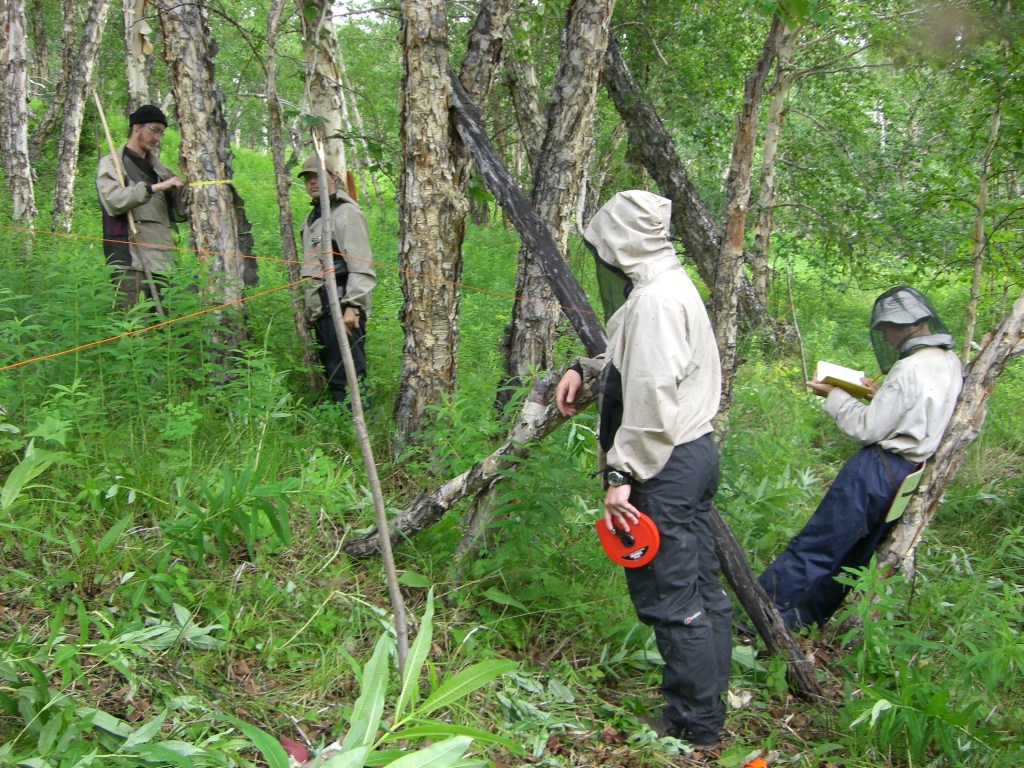
Picture 212

Over what distance do these Betula ermanii trees in Kamchatka compete with one another? I reckon around three metres but it’s not straightforward to work that out. That’s me on the far left, employing the most high-tech equipment available.

It might appear that I’m creating a straw man of scientific maxims, but I’m basing this rant on tenets I have received from reviewers of manuscripts, grant applications or been given as advice in person. Here are some things I’ve been told repeatedly:

  • Hypotheses should precede data collection. We all know this is nonsense. Take, for example, the global forest plot network established by the Center For Tropical Forest Science (CTFS). When Steve Hubbell and Robin Foster set up the first 50 ha plot on Barro Colorado Island, they did it because they needed data. The plots have led to many discoveries, with new papers coming out continuously. Much the same could be said of other fields, such as genome mapping. It would be absurd to claim that all the hypotheses should have been known at the start. Many people would refine this to say that the hypothesis should precede data analyses (as in most of macroecology) but that’s still not the way that our papers are structured.
  • Observations are not as powerful as experiments. This view is perhaps shifting with the acknowledgement that sophisticated methods of inference can strip patterns from detailed observations. For example, this nice paper using Bayesian analyses of a global dataset of tropical forests to discern the relationship between wood density and tree mortality. Ecologists frequently complain that there isn’t enough funding for long-term or large-scale datasets to be produced; we need to demonstrate that they are just as valuable as experiments, and recognising the importance of post-hoc explanations is an essential part of making this case. Perfect experimental design isn’t the ideal metric of scientific quality either; even weak experiments can yield interesting findings if interpreted appropriately.
  • Every good study should be a hypothesis test. We need to get over this idea. Many of the major questions in ecology are not hypothesis tests.** Over what horizontal scales do plants interact? To my mind the best element of this paper by Nicolas Barbier was that they determined the answer for desert shrubs empirically, by digging them up. If he’d tried to publish using that as the main focus, I doubt it would have made it into a top ecological journal. Yet that was the real, lasting contribution.

Still wondering what to say when the examiner turns to you and asks what science is? My answer would be: whatever gets you to an answer to the question at hand. I recommend reading up on the anarchistic model of science advocated by Paul Feyerabend. That’ll make your examiner pause for thought.


* What I’ve written is definitely a garbled approximation of Popper, but the more specific and doctrinaire one gets, the harder it becomes to achieve any form of consensus. Which is kind of my point.

** I’m not even considering applied ecology, where a practical outcome is in mind from the outset.

EDIT: added the direct quotation from Brookfield (2010) to make my point clearer.

The Law of Good Enough (or why your thesis will never be finished)

I spent quite a bit of time recently meeting our section’s post-graduate students for tutorials. In some cases this is to welcome new arrivals, or to catch up on progress from those who have been away on lengthy field seasons. The ones I most enjoy seeing are those  who are busy writing up — because they’re the ones I’m most able to help.

It can be difficult to persuade a postgrad staring down their thesis deadline that 15 minutes in my office is time well spent, which I fully understand. Usually they are stressed, feeling the pressure and unable to focus on anything other than the thesis. Much of this derives from a sentiment I hear echoed again and again in various forms: “I just want to do the best job I can”.

No. Stop. This is not the way to approach a thesis. You need your thesis to be good enough.

This shift in attitude is hard to accomplish when your whole academic career has been geared towards achieving the highest mark possible, or at the end of four years when you want to have something on your shelf to be proud of, that you can look at and think “I wrote that” and feel a warm glow inside. Allowing yourself to fall into this vanity trap is pathological, and the root cause of a lot of unnecessary stress on the part of post-graduates.

Your thesis is the means to an end, which is graduation. When the day comes, you will walk across a stage for 20 seconds, shake someone’s hand, collect a piece of paper and get a photo taken in a silly gown. It doesn’t matter if you’ve written the most perlucid, inspiring and impressive thesis of all time. No-one will clap any louder, or any longer. No-one will ever judge you on the quality of that thesis, good or bad. All that matters is that it was good enough.

In one of the labs I worked in we had a thesis that did the rounds of the post-graduates who were writing up. You might think that they were sharing a particularly wonderful thesis so as to learn best practice and be inspired by the achievements of others. I’m sure all the supervisors would have preferred that. But no, the thesis everyone wanted to see was singularly atrocious. No-one reading it could fail to spot glaring errors, hideous formatting and some of the worst figures ever committed to print. That’s exactly why everyone was so keen to read it — if this person passed then surely there was hope for others!

I’m not going to reveal whose thesis it was, because that doesn’t matter. They have gone on to a successful academic career where they are respected in their field with an international profile. Does anyone care that they submitted a shoddy thesis? Of course not. It was good enough. On the other hand, the best thesis I ever read remains that by Mike Shanahan, who preceded me by a couple of years and even worked at the same desk. Nothing could be more demoralising than to witness a standard of writing to which I had no hope of aspiring (at the time). Perhaps he still looks with satisfaction upon that thesis. He might do so again if he reads this. My bet is that it hasn’t crossed his mind in a decade or more. Did it benefit his career? Maybe, but probably not that much.

There is an argument that a better thesis will lead to an easier viva, and that’s perhaps the case, but my suspicion is that the correlation is not strong. How a viva goes depends on the personality of the examiners, their particular bugbears, the wind direction and the alignment of the stars. You can no more predict the questions than you can anticipate how many corrections you’re likely to get. The time to be a perfectionist, or at least to aim for the highest standards you can, is when you’re preparing a manuscript for publication. Then you know it’s going to be pored over in great detail. A publication is your contribution to the legacy of science, a work that will be forever associated with you. The thesis? That’s a bookend.

The best advice I ever received while writing up was from another old hand in the group who told me that a thesis is never finished. Eventually you just relinquish it to the examiners. Bear this in mind if you’re tempted to read and reread chapters, add more references, or tinker endlessly with the figures. There’s always something else you could do. Just get it done, make sure it’s good enough, then move on to the rest of your career.

—————————

Edit: @ZarahPattison made an interesting point on Twitter about thesis by publication. Although this is arguably the best possible way to prepare a thesis, it’s not for everyone, and many universities don’t even allow it. I wouldn’t like to give any student the idea that it was an expectation, not least because I didn’t manage it myself. It’s certainly true that a well-written chapter is easier to turn into a manuscript, but that’s missing the point. If you want to write a manuscript, write a manuscript. If you have a manuscript then turning it into a chapter is easy. If you need to finish a thesis then get the chapters done and worry about the manuscripts later.