Science Outreach Opportunities

MariaZygouropoulou

Guest post by Maria Zygouropoulou (@maria_zyg). 

At a recent meeting of our School’s post-grad management committee, Maria shared a document which she had put together describing the opportunities for students and academics to get involved in outreach activities. I thought this was too good to keep internal, and she has kindly agreed to let me repost it on the blog. Below she explains why you should get involved with outreach, how to do it, then a short bit about herself. Thanks Maria!


Shared Science = Powerful Science

The importance of engaging the public with science is becoming increasingly recognised; as an example, various MSc programmes in science communication are now on offer, public science festivals have sprung to life and outreach activities have become a compulsory requirement in many PhD programmes.

Why should we engage?

Although we sometimes forget, in most cases, our research money comes from public funding. Therefore, communicating our science back to the public is like saying ‘look, here is where your money was spent, thank you very much indeed’. If our research is not worth sharing then it is definitely not worth doing. Naturally, no-one is better placed to demonstrate the value and relevance of our research to the society than us. At the same time, simply by sharing we can also contribute towards building sustained support for our work. Furthermore, in the wider context of science, it is our responsibility to make science accessible and inclusive as well as to ensure that the public is well-informed about science. So next time you hear about the benefits of homoeopathy or that cracking your knuckles gives you arthritis think that at some point science was not communicated accurately or not communicated at all.

What is in it for us?

Engaging with the public can be fun and rewarding. You never know when and where you might plant a seed, but there is nothing more exhilarating than inspiring others with something that you are passionate about. And really it’s a two-way street: interacting with people other than your colleagues can sometimes help you realise the bigger picture of your research and see things in a new light. Of course, you will also have something extra to put in your CV and get to meet lots of like-minded, fun people and expand your network. Most importantly, communicating (your) science is easy and you can do it your own way: be it writing, painting, filming, speaking, social media… anything that suits you works. There is no wrong way of doing it, apart from not doing it at all!

Nevertheless, having recently joined the world of research as a PhD student, I appreciate that sometimes scientists find it hard to explain their science in a simple and universally communicable manner. Very often, scientific jargon, wordy slides and lack of enthusiasm spoil otherwise promising talks which in the end fail to communicate the most important points. I am even certain that some of us would prefer to write a peer-reviewed research article than to explain our work to a child, our grandma or even to a fellow scientist in a different field! Clearly, this is because we don’t do it enough… and since there are hardly any communication naturals, it takes practice!

If you don’t know where to start from, here is a list of a few good science communication opportunities/examples that might inspire you and help you on your way.

Some science communication opportunities (either for active participation or as a member of an audience):

A free online event where school students meet and interact with scientists. It’s an X Factor-style competition between scientists, where the students are the judges.

The 3MT concept was developed by the University of Queensland, Australia and has spread to universities around the world. The challenge is for researchers to explain the complexity and relevance of their research to a non-specialist audience in a concise and engaging way. Presenters have a maximum of three minutes to pitch their research and can only use one slide.

Based at Cambridge University’s Institute of Continuing Education (ICE), the Naked Scientists are a team of scientists, doctors and communicators whose passion is to help the general public to understand and engage with the worlds of science, technology and medicine. If you are interested in writing a guest article for the Naked Scientists website then please get in touch with articles@thenakedscientists.com with details about your background and interests.

PubhD is monthly event that started up in Nottingham. At each event, three PhD students, from any academic discipline, explain their work to an audience in a pub in exchange for a pint or two. The talks are at a ‘pub level’ – the idea is that you don’t have to be an academic to understand the talks.

Hosted by the British Science Association and CAMRA, Nottingham SciBar is a monthly event where a research scientist will present a short introduction to their work and how it affects all of us. This is followed by a friendly discussion interspersed with regular beer breaks. If you’re interested in science, and enjoy real ale pubs then we’d love for you to come along and enjoy an evening’s entertainment that stimulates those grey cells!

FameLab is a communications competition designed to engage and entertain by breaking down science, technology and engineering concepts into three minute presentations.

ScienceGrrl is a broad-based, grass-roots organisation celebrating and supporting women in science; a network of people who are passionate about passing on our love of science on to the next generation.

The VoYS Standing up for Science media workshops encourage early career researchers to get their voices heard in public debates about science.

Cafe Scientifique is a place where, for the price of a cup of coffee or a glass of wine, anyone can come to explore the latest ideas in science and technology. Meetings take place in cafes, bars, restaurants and even theatres, but always outside a traditional academic context.

The Pint of Science Festival brings some of the most brilliant scientists to your local pub to discuss their latest research and findings with you.

Festival of the Spoken Nerd is the science comedy phenomenon that will feed your brain, tickle your ribs and light your Bunsen burner. Full Frontal Nerdity guaranteed!

It’s a regular comedy night started in 2009 down in London that has academics getting up behind the mic and entertaining audiences about their subject/research. Over the past two years it has also kicked off several other branches in cities across the UK.

It’s a chaotic open mic night for scientists, science communicators, science teachers, historians and philosophers of science, students, science popularisers and anyone else with something to show off about science.

An independent press office helping to ensure that the public have access to the best scientific evidence and expertise through the news media when science hits the headlines. The Centre offers free places at its hugely popular ‘Introduction to the News Media’ events which give a flavour of what media work involves.

Horizon is an ongoing and long-running British documentary television series on BBC that covers science and philosophy. BBC offers work experience opportunities. A previous volunteer is here.

Formerly known as the British Interactive Group, BIG is a not-for-profit organisation for all people involved in informal science communication activities and hands-on education projects in the UK.

STEM Ambassadors volunteer their time and support to promote STEM subjects to young learners in a vast range of original, creative, practical and engaging ways. You can become a STEM ambassador yourself and participate in activities in your local area.

Professional Societies:

The J.A.M.s are a monthly junior seminar series aimed at integrating and connecting young researchers around the world. Each month a new junior researcher will be invited to present their work in a relaxed, friendly environment in an exciting and engaging way.

Each year the Biochemical Society looks for talented science communicators to take part in our annual Science Communication Competition. The competition is open to all undergraduate and postgraduate students. To enter, submit an original piece of writing or video on a biomolecular topic of your choice. Your article or video must be aimed at the general public and must be submitted with an entry form.

The Max Perutz Science Writing Award aims to encourage and recognise outstanding written communication among MRC PhD students. The annual competition challenges entrants to write an 800-word article for the general public answering the question: ‘Why does my research matter?’.

Check what your own society offers!

Some science communicators:

  • Prof Alice Roberts

  • Dr Adam Rutherford

  • Jon Wood

  • The Juggling Scientist

  • Sally Le Page

  • Mad Marc

Some advice, courtesy of TED(x), for any aspiring science communicator:


Bio

Maria Zygouropoulou (@maria_zyg) is a BBSRC-funded PhD student in the Synthetic Biology Research Centre of the University of Nottingham. She is currently trying to turn anaerobic bacteria into tiny superheroes that can help in the treatment of solid tumours. Previously, she obtained a Master in Pharmacy and worked in industry and hospital settings. She is Events Manager for the STEM Outreach society and Publicity Coordinator for the Nottingham Pint of Science festival. In her free time, she enjoys dancing salsa, baking, DIY decorating, puzzles and (occasionally) running!

A lie about my childhood


img270

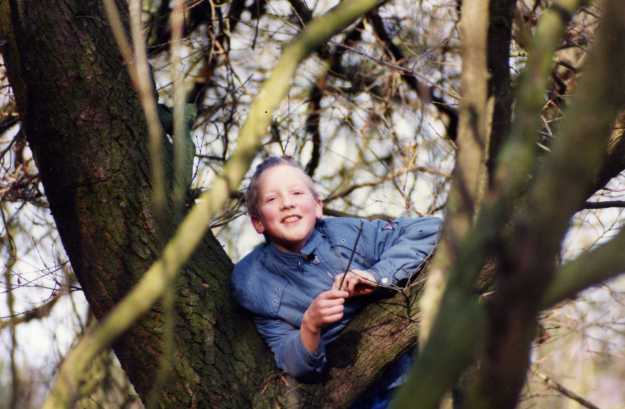
I would like you to believe that this is how I spent my entire childhood. It would be a lie, of course, but climbing trees was not uncharacteristic behaviour.

Anyone involved in admissions or graduate recruitment in ecology will be familiar with the stereotypical opening of the personal statement:

“When I was a child, I loved to play outside in nature. I watched the birds and the insects and the flowers and I knew that I wanted to spend my life studying them.”

Something along these lines opens the majority of the applications I read each year. Perhaps for some it’s actually true, though I suspect that most are teleological. Either the author is trying to convince me, or has already convinced themselves, that the whole direction of their life has been moving steadily and inexorably towards ecological research from their very first awakenings of consciousness.* Who am I, hard-hearted cynic, to stand in the way of manifest destiny?

Why am I so sceptical? I too am passionate about nature. I genuinely love being outdoors, collecting data, or simply observing natural systems and trying to figure out how they work. I grew up in the countryside and was most at peace when taking my dog for long walks through the fields and woodland or climbing trees. This bucolic upbringing is bound to have had a lasting influence on my chosen direction in life.

And yet… the evidence for a similar effect isn’t there from anyone else in the village, other than those who have continued on the family farm, for whom options were more limited. My siblings and friends from childhood include a doctor, dinner lady, teacher, policeman… none of whom are remotely associated with nature. There is one other academic, my older brother, who actually works on wood, or more strictly cellulose. That said, he’s a materials scientist and predominantly investigates its structural properties in the lab. He might enjoy long walks but he’s not an ecologist.**

img264

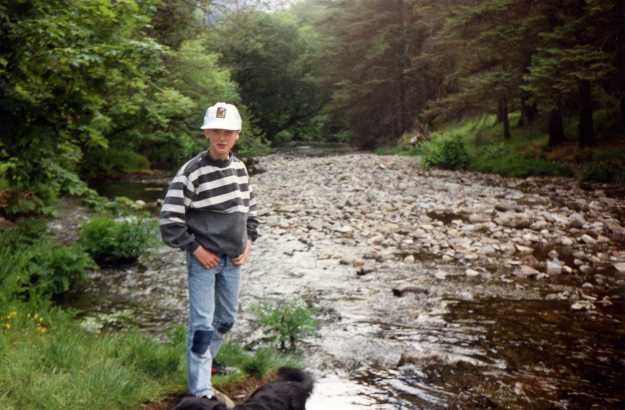
Another typical shot of my childhood. Note favourite dog just out of shot.

There are other anecdotes I could pull together to tell a partial story. We did tie old wellies to a rope and throw them in a pond to try and catch newts. That probably happened a handful of times and I don’t recall ever reeling in anything but mud. I remember my father encouraging me to help in the vegetable garden, and the excitement at eating my first crop of radishes. They were to be my only harvest, and any further assistance was through compulsion. It may be true that I once took myself off into the woods in Germany, disappearing for a whole day to the great consternation of my parents, then casually strolling back into town at dusk as the search parties were being assembled. I wasn’t lost in the embrace of nature; I just wanted to get away from the family for a bit.

I could tell a different story, of the boy who came home from school every evening and promptly ran upstairs to play Sensible Soccer on his Amiga until his hands developed callouses. The child who lagged behind on family walks bleating about the imposition.*** A bookworm, happier sat indoors reading science fiction than out in the sunshine. All these would be equally accurate, if similarly selective.

At no point was I ever a spotter or a collector, two traits that I frequently hear colleagues assert are key indicators of those with a great future in ecology. My plant taxonomy is entirely self-taught but was developed late and only in order to allow me to do fieldwork. It would be a lie to claim that I spent sunny afternoons as a child learning flowers. I do collect — mainly West African music and obscure European electronica. The boxes of entomological specimens I brought back from Borneo have languished in my office for over a decade, unidentified, and I retain them more through guilt than any abiding intention of rectifying this.

To this day I still have a profound disinterest in many aspects of the natural world. Quite honestly, I don’t care about birds. I couldn’t identify any British bird by song and the few I know by sight are only the most common. The idea of birdwatching as a leisure pursuit is anathema to me. Give me a glass of wine and a book any day.

There is at least one thing I recall from childhood that links directly to my current career, and where the narrative thread is not stretched to breaking point. I always — always — wanted to travel. My parents were well known for welcoming people from all over the world into their home. Their hospitality knew no bounds and I was lucky enough to be exposed to visitors from all manner of cultures and backgrounds. The superficial details are forgotten, and probably left little impression, but the undercurrent was an awareness of a wider and exotic world out there that I needed to see.

It was for that reason that I was so keen, while an undergraduate, to take part in an expedition to Kamchatka. It was there that I first realised that forest ecology was the path for me. Since then, and probably missing a few, I’ve worked in China, Malaysia, Mexico, Kenya, Tanzania, Russia, Australia, Uganda and all over Europe. I’ve made friends across the globe, eaten strange foods, drunk peculiar alcoholic beverages and danced awkwardly to mesmerising beats. I can sing songs in languages that I don’t even understand. I lost my religion and replaced it with a ever-widening appreciation of the breadth of human culture. And yes, I’ve seen some of the most incredible wild places on the planet, and returned with beautiful data.

Ecology was an excuse to travel, and the travel remains one of the great blessings of my job. It’s not the reason I do it — unravelling the mysteries of forest growth has long since taken over as my main obsession. Nevertheless, I’m fortunate enough to be writing this from a research station in Portugal where I’m teaching an undergraduate field course. Tonight I will drink local wine and plan the next adventure. It’s Mexico this summer, and I have an awesome collaborator in Ghana who really wants me to visit…

RIMG1176

This is the Quinta de Sao Pedro, just outside Lisbon, Portugal. If you’re looking for a location to run a field course then I can’t recommend it highly enough.


* Other ecologists have written about how the path into their current obsession was not a straight line, and involved large elements of chance and coincidence. Childhood experience may have played a part, but not the defining one.

** He did once cite me, although mostly for humorous reasons, and not entirely positively.

*** Like any child, I had phases. There were periods when I would run ahead, dashing round before collapsing in a heap exhausted. But to emphasise those while ignoring my awkward patches would create a false narrative.

Barnacles are much like trees

I am not a forest ecologist. OK, that’s not entirely true, as demonstrated by the strapline of this blog and the evidence on my research page. Nevertheless, having published papers on entomology, theoretical ecology and snail behaviour (that’s completely true), I’m not just a forest ecologist. Having now published a paper on barnacles, one could suspect that I’m having an identity crisis.

When a biologist is asked what they work on, the answer often depends on the audience. On the corridor that hosts my office, neighbouring colleagues might tell a generally-interested party that they work on spiders, snails, hoverflies or stickleback. Likewise, I usually tell people that I work on forests. When talking to a fellow ecologist, however, the answer is completely different, as it would be for every one of the colleagues mentioned above*.

If you walked up to me at a conference, or met me at a seminar, I would probably say that I work on spatial self-organisation in natural systems. If you were likely to be a mathematician or physicist** then I’d probably claim to study the emergent properties of spatially-structured systems. I might follow this up by saying that I’m mostly concerned with trees, but that would be a secondary point.

What I and all my colleagues have in common is that we are primarily interested in a question. The study organism is a means to an end. We might love the organism in question, rear them in our labs, grow them in our glasshouses, spend weeks catching or watching them in the field, learn the fine details of their taxonomy, or even collect them as a hobby… but in the end it is the fundamental question that drives our work. The general field of study always takes priority when describing your work to a fellow scientist.

appendix1

Behold the high-tech equipment used to survey barnacles. This is the kind of methodology a forest ecologist can really get behind.

The work on barnacles was done by a brilliant undergraduate student, Beki Hooper, for her final-year project***. The starting point was the theory of spatial interactions among organisms most clearly set out by Iain Couzin in this paper****. His basic argument is that organisms often interact negatively at short distances: they compete for food, or territorial space, or just bump into one another. On the other hand, interactions at longer ranges are often positive: organisms are better protected against predators, able to communicate with one another, and can receive all the benefits of being in a herd. Individuals that get too close to one another will move apart, but isolated individuals will move closer to their nearest neighbour. At some distance the trade-off between these forces will result in the maximum benefit.

Iain’s paper was all about vertebrates, and his main interest has been in the formation of shoals of fish or herds of animals (including humans). I’m interested in sessile species, in other words those that don’t move. Can we apply the same principles? I would argue that we can, and in fact, I’ve already applied the same ideas to trees.

What about barnacles? They’re interesting organisms because, although they don’t move as adults, to some extent they get to choose where they settle. Their larvae drift in ocean currents until they reach a suitable rock surface to which they can cling. They then crawl around and decide whether they can find a good spot to fix themselves. It’s a commitment that lasts a lifetime; get it wrong, and that might not be a long life.

If you know one thing about barnacles, it’s probably that they have enormously long penises for their size. Many species, including acorn barnacles, require physical contact with another individual to reproduce. This places an immediate spatial constraint on their settlement behaviour. More than 2.5 cm from another individual and they can’t mate; this is potentially disastrous. Previous studies have focussed on settling rules based on this proximity principle. They will also benefit from protection from exposure or predators.  On the other hand, settle too close to another barnacle and you run the risk of being crushed, pushed off the rock, or having to compete for other resources.

theory

Barnacles can be expected to interact negatively at short distances, but positively at slightly longer distances. This disparity in the ranges of interactions gives rise to the observed patterning of barnacles in nature.


What Beki found was that barnacles are most commonly found just beyond the point at which two barnacles would come into direct contact. They cluster as close as they possibly can, even to the point of touching, and even though this will have the side effect of restricting their growth.

Furthermore, Beki found that dead barnacles had more neighbours at that distance than would be expected by chance, and that particularly crowded patches had more dead barnacles in them. There is evidence that this pattern is structured by a trade-off between barnacles wanting to be close together, but not too close.

1a_all

On the left, the pattern of barnacles in a 20 cm quadrat. On the right, the weighted probability of finding another barnacle at increasing distance from any individual. A random pattern would have a value of 1. This shows that at short distances (less than 0.30 cm) you’re very unlikely to find another barnacle, but the most frequent distance is 0.36 cm. Where it crosses the line at 1 is where the benefits of being close exceed the costs.

Hence the title of our paper: too close for comfort. Barnacles deliberately choose to settle near to neighbours, even though this carries risks of being crowded out. The pattern we found was exactly that which would be expected if Iain Couzin’s model of interaction zones were determining the choices made by barnacles.

When trees disperse their seeds, they don’t get to decide where they land, they just have to put up with it. The patterns we see in tree distributions therefore reflect the mortality that takes place as they grow and compete with one another. This is also likely to take place in barnacles, but the interesting difference lies in the early decision by the larvae about where they settle.

Where do we go from here? I’m now developing barnacles as an alternative to trees for studying self-organisation in nature. The main benefit is that their life cycles are much shorter than trees, which means we can track the dynamics year-by-year. For trees this might take lifetimes. We can also scrape barnacles off rocks and see how the patterns actually assemble in real time. Clearing patches of forests for ecological research is generally frowned upon. The next step, working with Maria Dornelas at St. Andrews, will be to look at what happens when you have more than one species of barnacle. Ultimately we’re hoping to test these models of how spatial interactions can allow species to coexist. Cool, right?

The final message though is that as an ecologist you are defined by the question you work on rather than the study organism. If barnacles turn out to be a better study system for experimental tests then I can learn from them, and ultimately they might teach me to understand my forests a little bit better.


* Respectively: Sara Goodacre studies the effects of long-range dispersal on population genetics; Angus Davison the genetic mechanisms underpinning snail chirality; Francis Gilbert the evolution of imperfect mimicry; Andrew MacColl works on host-parasite coevolution. I have awesome colleagues.

** I’ve just had an abstract accepted for a maths conference, which will be a first for me, and slightly terrifying. I’ve given talks in mathematics departments before but this is an entirely new experience.

*** Beki is now an MSc student on the Erasmus+ program in Evolutionary Biology (MEME). Look out for her name, she’s going to have a great research career. Although I suspect that it won’t involve barnacles again.

**** Iain and I once shared a department at Leeds, many years ago. He’s now at Princeton. I’m in the East Midlands. I’m not complaining…

Free software for biologists pt. 3 – preparing figures

So far we’ve looked at software tools for handing and analysing data and for writing. Now it’s time to turn to the issue of making figures.

Early in my career, I wish someone had taken me to one side and explained just how important figures are. Too often I see students fretting over the text, reading endless reams of publications out of concern that they haven’t cited enough, or cited the right things. Or fine-tuning their statistical analyses far beyond the point at which it makes any meaningful difference. And yet when it comes to the figures, they slap something together using default formatting, almost as an afterthought.

Having recently written a textbook (shameless plug), it has only brought home to me how crucial figures are to whether your work will get used and cited*. The entry criterion for a study being used in a book isn’t necessarily the quality of science, volume of data or clarity of expression, though I would argue that all of these are high in the best papers. What really sets a paper apart is its figures. Most of us, when we read papers, look at the pictures, and often make a snap judgement based on those. If the figures are no good then the chances of anyone wading through your prose to pick out the gems of insight will be substantially reduced.

Here then is a useful rule of thumb: you should spend at least one working day preparing each figure in a manuscript. That’s after collecting and analysing the data, and after doing a first-pass inspection of the output. A whole day just fine-tuning and making sure that each final figure is carefully and concisely constructed. You might not do it all in one sitting; you may spend 75% of the time trying out multiple formats before settling on the best one. All this is time well spent. And if you’re going to put the time into preparing them then you should look into bespoke software that will improve the eventual output.

xkcd1945

Easy to use does not mean good quality! Comic by XKCD.

Presenting statistical outputs

If you’ve been following this series of posts then it will come as no shock that I don’t recommend any of Microsoft’s products for scientific data presentation. The default options for figures in Excel are designed for business users and are unsuitable for academic publication. Trying to reformat an Excel figure so that it is of the required quality is a long task, and one that has to be repeated from scratch every time**. Then saving it in the right format for most journals (a .tiff or .eps file) is even less straightforward. As an intermediate option, and for those who wish to remain in Excel, Daniel’s XL plugin is a set of tools for analysis and presentation that improve its functionality for scientists.

Needless to say, this is all easier in R with a few commands and, once you’ve figured it out, you can tweak and repeat with minimal effort (the ggplot2 package is especially good). The additional investment in learning R will be rewarded. In fact, I’d go so far as to say that R is worth the effort for preparing figures alone. No commercial product will offer the same versatility and quality.

foliage2

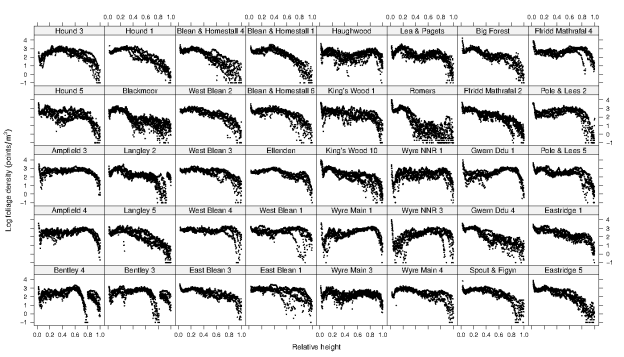
Here’s one I made earlier, showing foliage profiles in 40 woodlands across the UK. Try creating that in Excel.

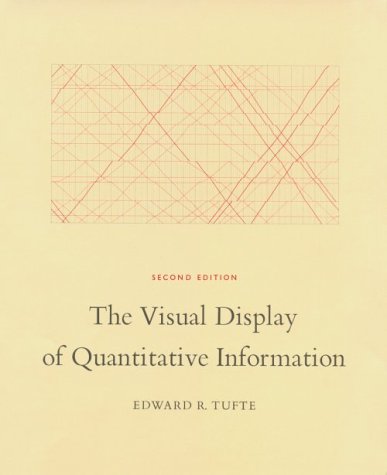
One of the reasons I recommend ggplot2 is that it is designed to follow the principles of data presentation outlined in Edward Tufte’s seminal book The Visual Display of Quantitative Information. It’s one of those books that people get evangelical about. It will change the way you think about presenting data, and forms the basis for the better scientific graphing tools.

visual-display-quantitative-information-tufte

What do you mean you haven’t read it? OK, you don’t have to, but it will convince you that data can be aesthetically pleasing as well as functional.

If you’re not an R user then a good alternative is the trusty gnuplot. Older readers can be forgiven for shedding a nostalgic tear, as this is one of the ancient software tools from the pre-internet age, having been around for about 30 years. It lives on, and has been continually maintained and developed, making it just as useful today as it was then.

A colleague pointed me towards D3.js, which is a JavaScript library that manipulates documents based on data input. I haven’t played with it but it might be an option for those who want to quickly generate standardised and reproducible reports.

Finally, if your main aim is to plot equations, then Octave is a free alternative to the commercial standard MATLAB. Only the most mathematical of biologists will want to use this though.

Diagrams

Some people try to produce diagrams using PowerPoint. No. Don’t do it. They will invariably look rubbish and unprofessional.

For drawing scientific diagrams, the class-leader is the fearsomely expensive Adobe Illustrator. Don’t even consider paying for your own license though because the free Inkscape will do almost everything you’ll ever need, unless you’re a professional graphic designer, in which case someone else is paying. Another free option is sK1 which has even more technical features should you need them. Xara Xtreme may have an awful name but it’s in active development and looks very promising. It’s also worth mentioning LibreOffice Draw, which comes as part of the standard LibreOffice installation.

One interesting tool I’m itching to try is Fiziko, which is a MetaPost script for preparing black-and-white illustrations for textbooks which mimic the appearance of blocky woodcuts or ink drawings. It looks like some effort and experience is required to use it though.

Image editing

The expensive commercial option is Photoshop, which is so ubiquitous that it has even become its own verb. For most users the free GIMP program will do everything they desire. I also sometimes use ImageMagick for image transformation, but mostly the command-line tool sam2p. Metadata attached to image files can be read and edited with ExifTool.

A common task in manuscripts is to create a simplified vector image, perhaps using a photo as a template. You might need to draw a map, show the structure of an organ or demonstrate an animal’s behaviour. For this there are specialist tools like Blender, Cheetah3D for Mac users or Google’s SketchUp, though the latter only offers a limited version for free download. Incidentally, never use a pixel art program (like Photoshop) to trace an image. All you end up with is a simplified pixel image of the original, which looks terrible. Plus you’ve paid for Photoshop.

For the rather specialised task of cropping and assembling documents from pdf files, briss might be an ancient piece of software but it’s still the go-to application.

Preparing outline maps (e.g. of study sites) is a common task and an expensive platform like ArcGIS is unnecessary. Luckily the free qGIS is almost as good and improving rapidly. There’s a guide to preparing maps here.

anglesey

A map showing the study site in a forthcoming paper (Hooper & Eichhorn 2016) and prepared by Jon Moore in qGIS.

There are countless programs out there for sorting, handling and viewing photographs (e.g. digiKam, Shotwell). Not being much of a photographer I’m not a connoisseur.

Flowcharts

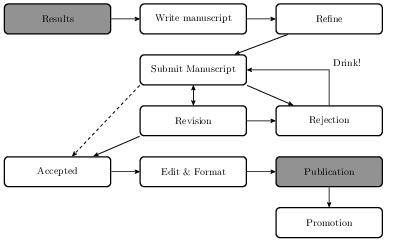
Flowcharts, organisational diagrams and other images with connected elements can be created in LibreOffice Draw. I’ve not used it for this though, and therefore can’t compare it effectively to commercial options like OmniGraffle, which is good but expensive for something you might not be doing regularly. A LaTeX-based option such as TikZ is my usual choice, and infinitely better than spending ages trying to get boxes to snap to a grid in Powerpoint. If you’re not planning to put the time into learning LaTeX then this is no help, but add it to the reasons why you might. If anyone knows of a particularly good FOSS solution to this issue then please add in the comments and I will update.

pdfmaker

I made this in TikZ to illustrate the publication process for my MSci class in research skills. I won’t lie, it took a long time (even as a LaTeX obsessive), and I’d like to find a more efficient means of creating these figures.

Animations

This is one task that R makes very easy. Take the output of a script that creates multiple PNG files from a loop and bundle them into an animation using QuickTime or the very straightforward FFmpeg. For something that looks so impressive, especially in a presentation, it’s surprisingly easy to do.

Collecting data

To collect data from images ImageJ is by far the best program, largely due to the immense number of specialist plug-ins. Some of these have been collected into a spin-off called Fiji, which provides a great set of tools for biologists. Whatever you need to do, someone has almost certainly written a plug-in for it. Note that R can also collect data from images and even interfaces with ImageMagick via the EBimage package. Load JPEGs with the ReadImage package and TIFF files with rtiff.

A common task if you’re redrawing figures, or preparing a meta-analysis, is to extract data from figures. This is especially common when trying to obtain data from papers published before the digital age, or when the authors haven’t put their original data online. For this, Engauge will serve your needs.

Next time: how to prepare presentations!


* At some point in the pre-digital age, maybe in the 90s, I recall an opinion piece by one textbook author making exactly this point. Was it Lawton, Krebs, Southwood… I really can’t remember. If anyone can point me in the right direction then I’d be grateful because I can’t track it down.

** I did overhear one very prominent ecologist declare only half-jokingly that they stopped listening to talks if they saw someone present an Excel figure because it indicated that the speaker didn’t know what they were doing. Obviously I wouldn’t advocate such an extreme position, but using Excel does send a signal, and it’s not a good one.

Free software for biologists pt. 2 – data management and analysis

This is the second part of a five-part series, collated here. Having covered writing tools in the last post, this time I’m focussing on creating something to write about.

Data management

Let’s assume that you’ve been out, conducted experiments or sampling regimes, and returned after much effort with a mountain of data. As scientists we invest much thought into how best to collect reliable data, and also in how to effectively analyse it. The intermediate stage — arranging, cleaning and processing the data — is often overlooked. Yet this can sometimes take as long as collecting the data in the first place, and specialist tools exist to make your life easier.

I’m not going to dwell here on good practices for data management; for that there’s an excellent guide produced by the British Ecological Society which says more than I could. The principles of data organisation are well covered in this paper by Hadley Wickham. Both are on the essential reading list for students in my group, and I’d recommend them to anyone. Instead my focus here is on the tools you can use to do it.

The familiar Microsoft Excel is fine for small datasets, but struggles with large spreadsheets, and if you’ve ever tried to load a sizeable amount of data into it then you’ll know that you might as well go away to make a cup of tea, come back and hope it hasn’t crashed. This is a problem with Excel, not your data. Incidentally, LibreOffice Calc is the free substitute for Excel if you want a straight replacement. Don’t even consider using either of them to do statistics or draw figures (on which there will be more next time). I consider this computational limitation more than enough reason to look elsewhere, even though there are many official and unofficial plug-ins which extend Excel’s capabilities. Excel can also reformat your data without you knowing about it.

One of the main functionalities lacking in Excel is a way to use GREP. Regular Expressions are powerful search terms that allow you to screen data, check for errors and fix problems. Learning how to use them properly will save all the time you used to spend scrolling through datasheets looking for problems until your mind went numb. Proper text editors allow this functionality. Personally I use jEdit to manage my data, which is available free for all operating systems. Learning to parse a .csv or .txt file that isn’t in a conventional box-format spreadsheet takes a little time but soon becomes routine.

For larger, linked databases, Microsoft Access used to be the class-leader. The later versions have compromised functionality for accessibility, leading many people to seek alternatives. Databases are compiled using SQL (Structured Query Language), and learning to use Access compels you to pick up the basics of this anyway. Given this, starting with a free alternative is no more difficult. I have always found MySQL to be easy and straightforward, but some colleagues strongly recommend SQLite. It might not have all the same functions of the larger database tools but most users won’t notice the difference. Most importantly, a database in SQL format can be transferred between any of these software tools with no loss of function.  Migrating into (or out of) Access is trickier.

As a general rule, your data management software should be used for that alone. The criterion for choosing what software to use is that it should allow you to clean your data and load it into an analysis platform as quickly and easily as possible. Don’t waste time producing summaries, figures or reports when this can be done more efficiently using proper tools.

Data analysis

These days no-one looks further than R. As a working environment it’s the ideal way to load and inspect data, carry out statistical tests, and produce publication-quality figures. Many people — including myself — do pretty much all their data processing, analysis and visualisation in R*.

It’s interesting to note just how rapidly the landscape has changed. As an undergraduate in the 90s we were taught using Minitab. For my PhD I did all my statistics in SPSS, then as a post-doc I transitioned to GenStat. All are perfectly decent, serviceable solutions for basic statistical analyses. Each has its limitations but moving between them isn’t difficult.

I won’t hide the simple truth — learning R is hard, especially if you have no experience of programming. Why then did I bother? The simple answer is that R can do everything that all the above programs can do, and more. It’s also more efficient, reproducible and adaptable. Once you have the code to do a particular set of analyses you can tweak, amend and reapply at will. Never again do you have to work through a lengthy menu, drag-and-drop variables, tick the right boxes and remember the exact sequence for next time. Once a piece of code is written, you keep it.

If you’re struggling then there are loads of websites providing advice to all levels from beginners to experienced statistical programmers. It’s also worth looking at the excellent books by Alain Zuur which I can’t recommend highly enough. If you have a problem then a quick internet search will usually retrieve an answer in no time, while the mailing lists are filled with incredibly helpful people**. The other great thing about R is that it’s free***.

One word of warning is to not dive too deep at the beginning. Start by replicating analyses you’re already familiar with, perhaps from previous papers. The Quick-R page is a good entry point. A bad (but common) way of beginning with R is to be told that you need to use a particular analytical approach, and that R is the only way to do it. This way leads at best to frustration, at worst to errors. If someone tells you to use approximate Bayesian inference via integrated nested Laplace approximation, then you can do it with the R-INLA package. The responsibility is still on you to know what you’re doing though; don’t expect someone to hold your hand.

Because R is a language rather than a program, the default environment isn’t very easy to work in, and you’re much better using another program to interface with R. By far the most widely-used is RStudio, and it’s the one I recommend to my own post-graduate students. It will improve your R coding experience immensely. Some programmers use it for almost everything. An alternative is Tinn-R, which I used to use, but gave up on a few years ago because it was too buggy. It may have improved now so by all means try it out. If you’re desperate for a familiar-looking graphical user interface with menus then R Commander provides one, but I recommend using this as a gateway to learning more (or teaching students) rather than a long-term solution.

I’m a bit old-fashioned and prefer to use a traditional text editor to work in R. My choice, for historical reasons, is eMacs, which links neatly to R through ESS. The other tribe of programmers use Vim with the sensibly-named Vim-R-plugin, and we shall speak no more of them. If you’re already a programmer then you know about these, and can be assured that you can code in R just as easily. If not then stick to Rstudio, which is much easier. I also often use Geany as a tool for making quick edits to scripts.

Most of all, don’t type directly into R, it’s a recipe for disaster, and removes the greatest advantage which is its reproducibility. Likewise don’t keep a Word document open with R commands while continually copy-and-pasting them over. I’ve seen many students doing this, and it’s only recommended if you want to speed the onset of repetitive strain injury. Word will also keep reformatting and autocorrecting your text, introducing many errors. Use a proper editor and it’s done in one click.

One issue with R that more experienced users will come across is that it is relatively slow at processing very large datasets or large numbers of files. This is a problem that relatively few users will encounter, and by that point most will be competent programmers. In these cases it’s worth learning one of the major programming languages for file handling. Python is the easiest to pick up, for which Rosalind provides a nice series of scaled problems for learning and teaching (albeit with a bioinformatics focus). Serious programmers will know of or already use C, which is more widespread and has greater power. Finding out how to use a Bash shell efficiently is also immensely helpful. Learning to program in these other languages will open many doors, including to alternative careers, but is not essential for most people.

As a final aside, there is a recent attempt to link the power of C with the statistical capabilities of R in a new programming language called Julia. This is still in early development but is worth keeping an eye on if statistical programming is likely to become a major feature of your research.

Specialist software tools

Almost everything can be done in R, and those that can’t already, can be programmed. That said, there are some bespoke free software tools that are worth mentioning as they can be of great use to ecologists. They’re also valuable for those who prefer a GUI (Graphical User Interface) and aren’t ready to move over to a command-line tool just yet. Where I know of them, I’ve mentioned the leading R packages too.

Diversity statistics — the majority of people now use the vegan package in R. Outside R, the most widely-used free tool for diversity analysis is EstimateS. Much of the same functionality is contained in SPADE, written by Anne Chao (who has a number of other free programs on her website). I’ve always found the latter to be a little buggy, but it’s also reliably updated with the very latest methods. It has more recently been converted into an R package, spadeR, which has an accessible webpage that will do all the analyses for you. As a final mention, there is good commercial software available from Pisces Conservation, but apart from a cleaner-looking interface I’ve never seen any advantage to using it.

GIS — I’ll be returning to the issue of making maps in a later post, but will mention here that a direct replacement for the expensive ArcGIS is the free qGIS. I’ve never found any functionality lacking, but I’m not a serious GIS user either. There are a plethora of R packages which in combination cover the same range of functions but I wouldn’t like to make recommendations.

MacroecologySAM (for Spatial Analysis in Macroecology) is a useful tool for quickly loading and inspecting patterns in spatial ecological data. I would personally still move into R for publication-grade analyses, but this can be a helpful stepping stone when exploring a new dataset.

Null models — these can be very useful in community ecology. The only time I’ve done this, I used the free version of EcoSim. I see that you now have to pay for the full version, so if someone can recommend a comparable R package in the comments then I’ll update this accordingly.

I’m happy to extend this list with further recommendations; please drop a note in the comments.

Further reading

Practical Computing for Biologists is a great book. A little knowledge goes a long way, and learning how to use the shell, regular expressions and a small amount of Python will soon reap dividends for your research, whatever stage you’re at.


* The most mathematically-inclined biologists might hanker after something more like MATLAB, for which a direct free replacement is GNU Octave. You can even transfer MATLAB programs across, although there are some minor differences in the language.

** Normal forum protocol applies here, which is that you shouldn’t ask a question to which you could reasonably have found an answer by searching for yourself. If you ask a stupid question that implies no effort on your part then you can expect a curt answer (or none at all).  That said, if you really can’t work something out then it’s well worth bringing up because you might be the first person to spot an issue. If your problem is an interesting one then often you’ll find yourself receiving support from some of the top names in the field, so long as you are willing to learn and engage. Please read the posting guide before you start.

*** A few years ago a graduate student declined my advice to use R, declaring in my office that if R was so good, someone would be charging for it. I was taken aback, perhaps because I take the logic of Free Open-Source Software for granted. If you’re unsure, then the main benefit is that it’s free to obtain and modify the original code. This means that someone has almost certainly created a specific tool to meet your research needs. Proprietary commercial software is aimed at the market and the average user, whereas open-source software can be tweaked and modified. The reason R is so powerful is that it’s used by so many people, many of whom are actively developing new tools and bringing them directly to your computer. Often these will be published in Journal of Statistical Software or more recently Methods in Ecology and Evolution.

 

Free software for biologists pt. 1 – writing tools

This is the first in a planned series of five posts, to cover (1) writing tools, (2) data management and analysis, (3) preparing figures, (4) writing presentations and (5) choosing a new operating system. They will eventually be collated here.

Document-writing tools

Microsoft Word remains the default word processing software for the majority of people. Its advantage is exactly that, which makes collaboration relatively straightforward. The track changes function is appreciated by many people, though I would argue it’s unnecessary and can lead to problems; see below for tips on collaborative writing.

If you’re going to be spending a large proportion of your life writing then Word is not the ideal solution, especially for scientists. On this point it’s worth making clear that `scientist’ is just another word for `writer’. We write constantly — papers, grant proposals, lecture notes, articles and books. Professional writers use other commercial software such as Scrivener; this however is just paying for something different. Microsoft Word has improved in recent years, but there are still problems. The main limitations are:

  • It’s terrible at handling large documents (e.g. theses, or anything more than a couple of pages). Do you really need to do all that scrolling?
  • Including equations or mathematical script is difficult and always looks poor quality.
  • Embedded images are reproduced at low resolution.
  • Files are unnecessarily large in size.
  • The .docx format is very unstable. Send it to a collaborator on another computer (even with Windows) and it will appear different, with mangled formatting.
  • The default appearance doesn’t look very professional, and improving it takes forever.
  • It keeps reformatting everything as you go along, particularly when you combine sections from different documents.

I didn’t realise how much time was spent fighting Word’s defaults until I tried other software. Escaping isn’t tricky, as this blog post reveals. Several options are available to the scientific writer, and will improve both the quality and the experience of writing.

LibreOffice Writer. Want something that looks exactly like Microsoft Word, does everything that Word does, but don’t fancy paying for it? Just download LibreOffice and you’ll find it works equally well (if not better). This is perhaps the best option if you have an out-of-date or bootlegged version of Word and can’t access updates. With LibreOffice you will be able to open, edit and share all of your existing Word documents, and even save them in .doc format. The native format is .odt (for open document text). This is recommended as a stable document format by the British Government, which tells you something. Your Word-using colleagues will be able to open them as well.

Markdown. This has grown in popularity with scientists as it’s easier to use than professional tools such as LaTeX (see below) but provides many of the document-formatting tasks that scientists need. You can even write Markdown scripts in Word, but why would you. Combining it with pandoc makes it even more powerful because you can convert a Markdown template into any other format to match the requirements of a journal (or your collaborators). This is much easier to do than with LaTeX, which requires some programming nous. A good, free Markdown editor is Retext.

LaTeX. The gold standard, as used by many professional writers and editors (it’s pronounced lay-tech; the final letter is a chi). All my handouts are prepared in LaTeX, as are my presentations, manuscripts, in fact pretty much everything I write apart from e-mails. The problem is that learning LaTeX takes time. Most word processor programs run on the principle of WYSIWYG (What You See Is What You Get), whereas in LaTeX you need to explicitly state the formatting as you go along.

There are a number of gateway programs which allow you to write in LaTeX but with a more familiar writing environment. These therefore ease the transition and can show you the potential. I know many people who swear by LyX. My preferred editor is Kile, though this will involve a steeper learning curve. A great help while writing in LaTeX is to be able to see what the document looks like as you write. I pair Kile with Okular, but there are many other options that are equally good.

As a health warning, before diving into the deep end, bear in mind that working in LaTeX will initially be much slower. It takes time to become competent, and there are annoying side issues that remain frustrating (installing new fonts, for example, is bizarrely complex). While the majority of journals and publishers accept LaTeX submissions, and most will provide a template to format your manuscripts, there are still a few who require .doc format. This is changing though due to demand on the part of authors.

Collaborative writing

In the old days, when you collaborated on writing a paper, it required dozens of e-mails to be sent round as each author added her comments. Version control became impossible as soon as there were multiple copies and it was easy to lose track. Some people persist in working this way despite the fact that there are loads of tools that make this unnecessary. By using an online collaborative-writing site, multiple authors can contribute simultaneously, and you can even chat to each other while you’re at it.

The best-known is of course Google Docs which has the virtue of a familiar interface. It’s not designed for scientific writing though, and unsurprisingly there are more specific tools out there. While I’ve not used it, Fidus Writer looks like a promising option with a familiar layout to Google Docs but more better suited to the demands of science writing.

The one I’ve used most often is Authorea, which has the major advantage that anyone can write in any style and on any platform. This means that one person can write the technical parts in LaTeX while another adds sections Markdown, or you can cut-and-paste text from a normal word processor. The final document can be exported in your format of choice. This solves the problem of having all your collaborators needing to use the same software. My favoured option (for LaTeX users only) is shareLaTeX, though writeLaTeX looks to be equally good.

I haven’t mentioned GitHub here, even though I know many people who use it to maintain version history in collaborative work. This is particularly true of programmers who need to trace changes in code as it’s being developed. The same functionality can be very helpful in writing manuscripts, but using GitHub is not easy to use and it’s rare in biology that you will find yourself working with a pool of collaborators who know what they’re doing.

As a final note, I discourage the use of tracked changes due to many bad experiences. The main issue is that once more than one person has commented on a document it gets completely mangled, and it can take a long time to reconstruct the flow of the text once all the contradictory changes have been accepted. Furthermore, if your reason for having a WYSIWYG processor is that you want to see how the final document will look, then tracked changes remove that benefit and make your document unreadable. Lastly, whenever I’ve been forced into using them (in one notable occasion by a journal editor) it has invariably introduced errors into the text. By using some of the software recommended here there should be no need for the track changes function at all.

References and citations

The old standard for reference management used to be Endnote, which is an expensive solution if you don’t have either an institutional license or a student discount. Much the same can be said of Papers, which I hear is excellent but have never used.

I strongly recommend Mendeley to all my students. Think of it as iTunes for papers. It’s free and integrates smoothly with all the word processing software above. Even better is the online functionality which means you can synchronise documents across all your devices, including a commenting function, and share with colleagues. So you can read a PDF on the train, make notes on it, then open your office computer and retrieve all the notes straight away before dropping the citation directly into your manuscript. There are many tutorials online and the few hours you spend learning to use it will be rewarded by much time saved. Apparently Zotero, which is also free, offers similar functionality, but I’ve not tried it.

Having said all that, I don’t use Mendeley. If you’re using LaTeX then citing references is done through BibTeX, and I prefer kBibTeX to manage my reference library as it integrates nicely with Kile. This is only a personal choice though, and Mendeley would achieve the same result.


In praise of backwards thinking

What is science? This is a favourite opening gambit of some external examiners in viva voce examinations. PhD students, be warned! Imagine yourself in that position, caught off-guard, expected to produce some pithy epithet that somehow encompasses exactly what it is that we do.

It’s likely that in such a situation most of us would jabber something regarding the standard narrative progression from observation to hypothesis then testing through experimentation. We may even mumble about the need for statistical analysis of data to test whether the outcome differs from a reasonable null hypothesis. This is, after all, the sine qua non of scientific enquiry, and we’re all aware of such pronouncements on the correct way to do science, or at least some garbled approximation of them.* It’s the model followed by multiple textbooks aimed at biology students.

Pause and think about this in a little more depth. How many great advances in ecology, or how many publications on your own CV, have come through that route? Maybe some, and if so then well done, but many people will recognise the following routes:

  • You stumble upon a fantastic data repository. It takes you a little while to work out what to do with it (there must be something…) but eventually an idea springs to mind. It might even be your own data — this paper of mine only came about because I was learning about a new statistical technique and remembered that I still had some old data to play with.
  • In an experiment designed to test something entirely different, you spot a serendipitous pattern that suggests something more interesting. Tossing away your original idea, you analyse the data with another question in mind.
  • After years of monitoring an ecological community, you commence descriptive analyses with the aim of getting something out of it. It takes time to work out what’s going on, but on the basis of this you come up with some retrospective hypotheses as to what might have happened.

Are any of these bad ways to do science, or are they just realistic? Purists may object, but I would say that all of these are perfectly valid and can lead to excellent research. Why is it then that, when writing up our manuscripts, we feel obliged — or are compelled — to contort our work into a fantasy in which we had the prescience to sense the outcome before we even began?

We maintain this stance despite the fact that most major advances in science have not proceeded through this route. We need to recognise that descriptive science is both valid and necessary. Parameter estimation and refinement often has more impact than testing a daring new hypothesis. I for one am entranced by a simple question: over what range do individual forest trees compete with one another? The question is one that can only be answered with an empirical value. To quote a favourite passage from a review:

“Biology is pervaded by the mistaken idea that the formulation of qualitative hypotheses, which can be resolved in a discrete unequivocal way, is the benchmark of incisive scientific thinking. We should embrace the idea that important biological answers truly come in a quantitative form and that parameter estimation from data is as important an activity in biology as it is in the other sciences.”Brookfield (2010)

Picture 212

Over what distance do these Betula ermanii trees in Kamchatka compete with one another? I reckon around three metres but it’s not straightforward to work that out. That’s me on the far left, employing the most high-tech equipment available.

It might appear that I’m creating a straw man of scientific maxims, but I’m basing this rant on tenets I have received from reviewers of manuscripts, grant applications or been given as advice in person. Here are some things I’ve been told repeatedly:

  • Hypotheses should precede data collection. We all know this is nonsense. Take, for example, the global forest plot network established by the Center For Tropical Forest Science (CTFS). When Steve Hubbell and Robin Foster set up the first 50 ha plot on Barro Colorado Island, they did it because they needed data. The plots have led to many discoveries, with new papers coming out continuously. Much the same could be said of other fields, such as genome mapping. It would be absurd to claim that all the hypotheses should have been known at the start. Many people would refine this to say that the hypothesis should precede data analyses (as in most of macroecology) but that’s still not the way that our papers are structured.
  • Observations are not as powerful as experiments. This view is perhaps shifting with the acknowledgement that sophisticated methods of inference can strip patterns from detailed observations. For example, this nice paper using Bayesian analyses of a global dataset of tropical forests to discern the relationship between wood density and tree mortality. Ecologists frequently complain that there isn’t enough funding for long-term or large-scale datasets to be produced; we need to demonstrate that they are just as valuable as experiments, and recognising the importance of post-hoc explanations is an essential part of making this case. Perfect experimental design isn’t the ideal metric of scientific quality either; even weak experiments can yield interesting findings if interpreted appropriately.
  • Every good study should be a hypothesis test. We need to get over this idea. Many of the major questions in ecology are not hypothesis tests.** Over what horizontal scales do plants interact? To my mind the best element of this paper by Nicolas Barbier was that they determined the answer for desert shrubs empirically, by digging them up. If he’d tried to publish using that as the main focus, I doubt it would have made it into a top ecological journal. Yet that was the real, lasting contribution.

Still wondering what to say when the examiner turns to you and asks what science is? My answer would be: whatever gets you to an answer to the question at hand. I recommend reading up on the anarchistic model of science advocated by Paul Feyerabend. That’ll make your examiner pause for thought.


* What I’ve written is definitely a garbled approximation of Popper, but the more specific and doctrinaire one gets, the harder it becomes to achieve any form of consensus. Which is kind of my point.

** I’m not even considering applied ecology, where a practical outcome is in mind from the outset.

EDIT: added the direct quotation from Brookfield (2010) to make my point clearer.

Two lumps please

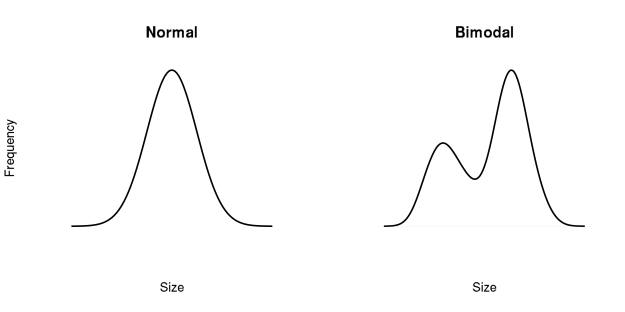
Here’s a quick thought experiment. Imagine you have a spare flowerbed in your garden, in which you scatter a handful of seeds across the bare ground. You then ignore them, and come back some months later. What will have happened?* Your expectation might be that you will have a healthy patch of plants, all about the same size. Some might be larger or smaller than average, but overall you’d expect them to be pretty similar. This is known as a unimodal size distribution. They have after all experienced identical conditions.

You’d be wrong. In fact, it’s more likely that your plants will have separated into two or more size groupings. There will be a set of larger plants, spread apart from one another, and which dominate the newly-formed canopy. In between them will be scattered other plants of smaller size. This results in a bimodal (or multimodal) size distribution. There isn’t a standard, expected size; instead there will be different size classes present.

modes.png

A normal, unimodal distribution of sizes (left) is what you might expect to see when all plants are the same age and growing in the same conditions. In fact it’s more common to see a bimodal size distribution (right), or something even more complicated.

This observation is nothing new. Much was written about the issue from the 1950s through to the 70s, particularly in the context of forest stands. The phenomenon was widely-recognised but remained paradoxical.

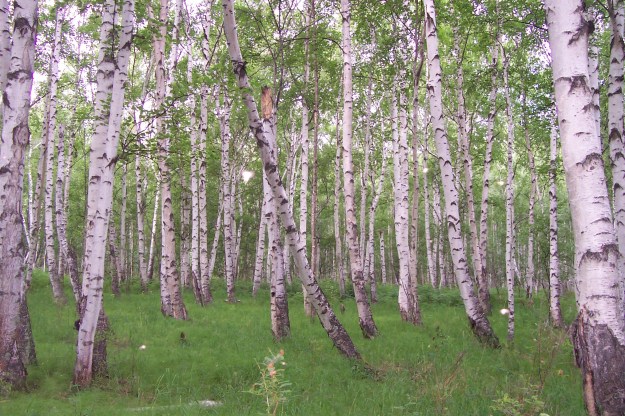
I stumbled upon this old literature back in 2010 when I published a small paper based on a birch forest in Kamchatka which showed a clearly bimodal size distribution. I didn’t need to go all the way to Kamchatka to find a stand with this feature; but since I had the data it made sense to use it. I used the spatial pattern of stems to infer that the bimodality was the result of asymmetric competition (i.e. that large trees obtain disproportionately more resources than small trees, which is definitely true in terms of light capture). All the trees were the same age, but the larger stems were spread out, with the smaller stems in the interstices between them. Had the bimodality been the result of environmental drivers we would expect there to be patches of large and small stems, but in fact they were all mixed together.

White birch forest, central Kamchatka

This is the stand of Betula platyphylla with a bimodal size distribution that was described in Eichhorn (2010). If it looks familiar, it’s because the strapline of this blog is a picture of us surveying it. The white lights on the photo aren’t faeries, it’s the reflectance of mosquito wings from the camera flash. So many mosquitoes.

Three things struck me when I was reading the literature. The first was that hardly anyone had thought about multimodal size distributions in cohorts for several decades**. This was a forgotten problem. The second was that the last major review of the phenomenon back in 1987 had concluded that asymmetric competition was the least likely cause — which conflicted with my own conclusions. Finally, I had no difficulty in finding other examples of multimodal size distributions in the literature, but authors kept dismissing them as anomalous. I wasn’t convinced.

Analysing spatial patterns is all well and good but if you want to really demonstrate that a particular process is important, you need to create a model. Enter Jorge Velazquez, who was a post-doc with me at the time but now has a faculty position in Mexico. He built a simple model in which trees occupy fixed positions in space and can only obtain resources from an the area immediately around themselves. Larger trees can obtain resources from a greater area. When two trees are close to one another, their intake areas overlap, leading to competition for resources.

overlap.png

When there are two individual trees (i and j), each of which obtains resources from within a radius proportional to its size m, the overlap is determined by the distance d between them. Within the area of overlap the amount of resources that each receives depends on the degree of asymmetric competition, i.e. how much of an advantage one gets by being larger than the other. This is included in the model as a parameter described below.

This is where asymmetric competition is introduced as a parameter p. When = 0, competition is symmetric, and resources are evenly divided between two trees when their intake areas overlap. When = 1, each tree receives resources in direct proportion to its size  (i.e. a tree that’s twice as large will receive two thirds of the available resources). Increasing makes competition ever more asymmetric, such that the larger competitor receives a greater fraction of the resources being competed for. In nature we expect asymmetric competition to be strong because a taller tree will capture most of the light and leave very little for those beneath it.

We applied the model to data from a set of forest plots from New Zealand which have already been well-studied. Not only did we discover that two thirds of these plots had multimodal size distributions, but also that our model could reproduce them.

We then started running our own thought experiments. What if you changed the starting patterns, making them clustered, random or dispersed? That turned out to have very little effect on size distributions. What about completely regular patterns? That’s when things started to get really interesting.

By testing the model with different patterns we discovered three important things:

  • Asymmetric competition is the only process which consistently causes multimodal size distributions within simulated cohorts of plants. Nothing else we tried worked.
  • Asymmetric competition is the cause, not the consequence of size differences in the population.
  • The separation of modes is determined by the length of time it takes for competition in the cohort to start, which usually reflects the distance between individuals.
  • The number of modes reflects the effective number of competitors that each individual has.

What does all this mean? Given that asymmetric competition is normal for plants, I would argue that we should expect to see multimodal size distributions everywhere. In fact, seeing unimodal size distributions should be a surprise. Don’t believe me? Grab some seeds, give it a go, and tell me if I’m wrong.

You can read our new paper on the subject here. If you can’t get hold of a copy then let me know.


* Luckily this is a thought experiment, because in my garden the usual answer is ‘everything has been eaten by slugs’.

** I should stress here that I’m specifically referring to multimodality in size distributions of equal-aged cohorts. When several generations overlap then the distribution of sizes reflects the ages of the individuals. If multiple species are present this adds additional complications, and in fact size distributions of species across communities have been a hot topic in the literature of late. This is very interesting but a completely different set of processes are at work.

Unpublished works

A few years ago I attended a workshop session on publishing for early-career scientists. One earnest delegate spoke up in favour of submitting work to local journals, especially if you work overseas. It helps build science in your host country, demonstrates willingness to engage with their institutions, and ensures that all your research gets published — even the bits that more prestigious journals might look down upon. For many natural history observations this is about the only way to get such findings into the literature.

I politely disagreed, specifically for early-career researchers, while accepting all the points they made. There is an important skill to learn, and it’s that of letting go. If you can write the big prestigious paper, then write the big prestigious paper. If you can’t, go back to the field/lab/computer and get the data you need to write it. Don’t waste time on the small stuff. It won’t help your CV, and all these noble intentions count for little if you don’t get a job. Recruitment panels won’t care about your lovely paper in the Guatemalan Nature Journal*.

Some people believe that all this unpublished work is a problem for science. Jarrod Hadfield recently wrote, in a provocative meeting report for the Methods in Ecology and Evolution blog, that preregistration of analyses would ensure that “the underworld of unpublished studies would be exposed and their detrimental effects could be adjusted for.” He notes, then dismisses, concerns about the extra workload involved or the frequent changes of plans that take place due to unforeseen circumstances.

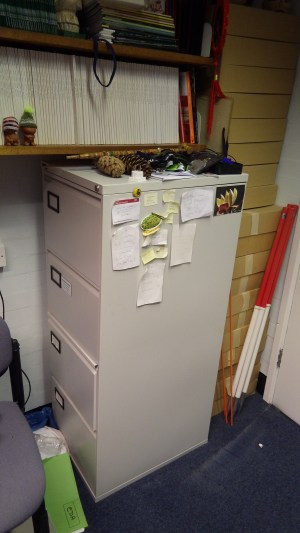
Would you, as Orpheus, wish to venture into the underworld? Then look upon my file drawer and weep.

RIMG1158

The cabinet of broken dreams. Beware: when you gaze into the file drawer, the file drawer also gazes into you.

This is filled with countless manuscripts at various stages of abandonment. Much sound data collected during my PhD with blood, sweat and tears (all quite literally) languishes here, almost certain to never see the light of day. Likewise there is still unpublished data from my second post-doc. Why have I allowed so many potential publications to rot? How can I live with myself while denying the wider scientific community access to this information?

There’s a simple answer — I had more important things to do. Every active decision you make in life to do something has a consequence elsewhere. Even writing this post. Sometimes I needed to work on another, better paper. The rest of the time I had to do all the things that keep me employed (teaching, administration, grant applications) or sane (sleeping, reading, holidays, drinking).

One thing I’ve learnt in recent years is that the hassle of publishing in a small journal isn’t that much lower than a large journal. There are several reasons for this:

  • Preparing the manuscript is no less time-consuming. Even though the expectations for data quality might be lower, the processes of analysing data, finding and reading the literature, preparing figures and putting everything together are much the same.
  • The quality of reviews is often lower for smaller journals (or at least the variance in quality is higher), increasing the amount of time it takes to respond to them. This shouldn’t be the case, but experience clearly indicates that it is.** Don’t vainly expect the journal to be simply grateful to receive your submission.
  • Lower-ranking journals employ smaller editing teams working with fewer resources. This might not seem like a big deal, but once your paper is accepted it makes all the difference. In a mainstream journal the proofs are turned around quickly and without fuss. It can be on the website in no time. In minor journals you might end up doing much of the legwork yourself. ***

There are sometimes good reasons to publish in a small journal. If you’ve put all the effort into writing a manuscript that was rejected higher up, then go for it, you’ve already invested the time ****. When moving into a new field I like to publish something small just to prove to myself that I can; it also helps with getting my head around a new literature. As a student there’s also great value in getting your first publication anywhere you can, just to experience the process.

What I advise against is writing a paper which you intend from the outset to submit to a small journal. Many studies in ecology don’t get published solely because there’s something better to do. Maybe the results were too complicated to tell a neat story, or couldn’t be easily explained. Maybe all the tests came out insignificant. Given a choice, any scientist should write up the paper with the greatest chance of getting published in a good journal. The small ones are unlikely to provide the same return on your time investment.

The file drawer problem doesn’t occur because we have something to hide, although this may well be true of medical trials or in some highly competitive fields. It’s mostly because we don’t have time. Learn to let go or else the ghosts of unpublished papers will haunt you for the rest of your career.


* Don’t get upset with me over whether they should, the point is that they don’t.

** The reason is pretty obvious. If I receive a review request from Big Name Journal then I know that (a) the authors thought it was important enough to submit there and (b) a specialist editor agreed with them. I’m therefore likely to be interested in it. On the other hand, if I receive a review request from Journal Named After Taxon, I might see which of the post-grads is checking Facebook and offer them a valuable learning experience.

*** In one case I’ve spent more time on editing post-acceptance than I did on writing the paper. I won’t reveal which, but let’s just say that their demands corresponded to neither the website’s Instructions to Authors nor the Chicago Manual of Style.

**** This is only true if your paper was rejected either for not being a good fit or for not quite being interesting or novel enough. If there were fundamental and irredeemable errors with the work then persisting would be a case of Concorde fallacy. Chalk it down to experience and concentrate on fixing the problems for the next manuscript.

That Glorious Forest


thatgloriousforest

There’s no denying that Sir Ghillean Prance FRS is one of the most distinguished tropical botanists alive today. His contributions to the scientific literature have been immense, particularly regarding the floral biogeography of Amazonia, not to mention numerous taxonomic identifications and specimens distributed in herbaria throughout the world. For over ten years he was the director of Kew Gardens, one of the foremost centres of plant research and discovery. Moreover, he has conducted 56 expeditions to South America over a long career, with recollections of these forests and the societies contained within them that date back before the incursions of the modern world. His is a story which deserves to be told.

I love reading the memoirs of the great exploratory botanists*. The hardships they willingly accepted in pursuit of plants are an inspiration, along with the thrill of true discovery at a time when so many parts of the globe could only be reached through daring exploits. I’ve been on my fair share of remote expeditions, but in these days of long-haul flights, widespread airports, tarmacked roads and satellite phones, the challenge is now more one of escaping modernity than coping without it. Reading the exploits of our predecessors, before health and safety became the deadening preoccupation of adventurers, is a refreshing antidote.

With such easy material, combined with abundant photographic records, Prance could hardly fail to produce an engaging account of his career in the tropics. And yet… it’s not written in the most gripping style. The opening chapters of That Glorious Forest read something like a school pupil’s summer diary, dominated by mundane observations interspersed with trivial details and almost entirely stripped of the passion and enthusiasm that must surely have driven his work and made such hardships endurable. To take one incident as an example, Prance once found himself spending the night in a jail cell in a remote border town. The potential for a ripping yarn gets even better, as he only ended up there after a fraught flight across the Amazon forest in a dilapidated DC-8 during which first one, then the second engine failed, necessitating an emergency landing. Stranded in a small town with little accommodation, the only place to house them for a night was the local jail. This story would be gold to a biographer. Yet we are told nothing about the reactions of the people on the plane, their emotions, the responses of the people on the ground. Were there prisoners in other cells at the time? How well did everyone manage to sleep? Instead we are told only the sparest details, a plot outline instead of a hair-raising adventure. For once I found myself longing for more information rather than less.

What remains isn’t so much an absorbing account of derring-do in the name of science, but a much-condensed summary, combined with a desire to name and thank everyone with whom his path has crossed. The latter is noble, even endearing, but the general reader gains little from it. As I can vouchsafe from my own expeditions, the most entertaining stories usually derive from the more unpleasant people one ends up encountering, and the same is true here.

If you’re looking for peril, it’s most often associated with a botanist’s greatest fear: plant presses catching fire. The potential loss of hard-won specimens is what keeps any field collector awake at night. I appreciated the details of the plants collected and the stories behind them — these are among the best bits, often infused with emotion. A botanist to the end, each chapter concludes with the accession numbers of all specimens collected over the course of the events described, along with the type specimens for all new species discovered. This makes up an impressive tally.

Ghillean-Prance-victoria

Ghillean Prance inspecting the underside of a leaf of Victoria amazonica

As for the adventures themselves, I began to gain the impression that each expedition had been described in the manner of a botanical specimen, each inflorescence reduced to a floral formula; flattened, dessicated and inspected for its features alone. Having never met Prance, I have no idea whether this is typical of either the man or his attitude to life, but given how keen I was to enjoy this book, I was disappointed by the dry writing style. A telling comment appears halfway through, in a passing remark about having met the author Redmond O’Hanlon, whose tales of travels with the Yanomani of Venezuala are one of the great accounts of this region. “I commented that I would be really ashamed to run an expedition like that, but that as a writer, he had to have so many misfortunes to make a good story!” This seems doubly unfair, as there are no shortage of mishaps in Prance’s own travels, but also because these do not in themselves make for a readable account. The photos and illustrations throughout are wonderful, and the production quality is excellent, making it great value for $69. It’s not meant as a coffee-table book though, and therefore doesn’t quite fit that niche either.

That said, there are some genuinely interesting anecdotes. A field trip to collect fruitflies with the great geneticist Dobzhansky was enlivened by his insistence on carrying mashed bananas all the way across Brazil to the Yanomani, whose staple crop is… bananas. He appears to have been a demanding and eccentric guest, though is thought of affectionately enough to be called ‘Dobbie’ throughout.

Some of the best passages involve Prance’s encounters and working relationship with forest-dwelling people. On meeting the Yanomani: “They were curious about us and were stroking my hairy arms and chest, making their clicking noises of appreciation. When they wanted to see more, I just stripped completely and their curiosity was satisfied.” If this sounds strange, then it’s worth remembering that the Yanomani spend their lives naked. One of the fungi they eat translates as hairy-arse fungus. Elsewhere there are intriguing ethnobotanical observations, whose value is underestimated by the modern scientific literature. For example, the Mak\’u people use the milky sap of a fig species (Naucleopsis mello-barretoi) as a poison for blowpipe darts. The toxin is a cardiac glycoside, only known to occur elsewhere in another genus of the Moraceae, and only in New Guinea — where the natives have similarly discovered its utility as  a hunting poison.

If you want to read a book documenting the ethnobotany of the neotropics, and the efforts of bold scientists to describe it, then Wade Davis’ magnificent memoir One River still leads the way. It is informed by his own personal account of travels in search of plants, interspersed with anecdotes and partial biographies of the legendary botanist Richard Evans Schultes and his distinguished student Tim Plowman. It’s a book which, had I read two decades earlier, would have changed the whole trajectory of my career. Schultes never wrote up his own memoirs, while Plowman died tragically young; it took Davis to transform the raw materials of their lives into an appealing narrative. Letting the human story drive the text only served to increase the thrill of the botanical chase behind it. By the end of That Glorious Forest I couldn’t help wishing that Prance had taken a similar approach.


* My next challenge is reading another memoir by a living legend of tropical taxonomy, this time from the Orient — Peter Ashton’s mammoth On the Forests of Tropical Asia. It’s 800 pages long and weighs a tonne though, so don’t expect the review to follow any time soon.